
 Home /
Product Packaging Engineering Services: Balancing Protection, Cost, and Manufacturing Reliability


Product Packaging Engineering Services encompasses designing the structure and deciding on the material used as well as cushioning system design. Our experience in manufacturing and transportation testing helps us in validation of the product packaging.
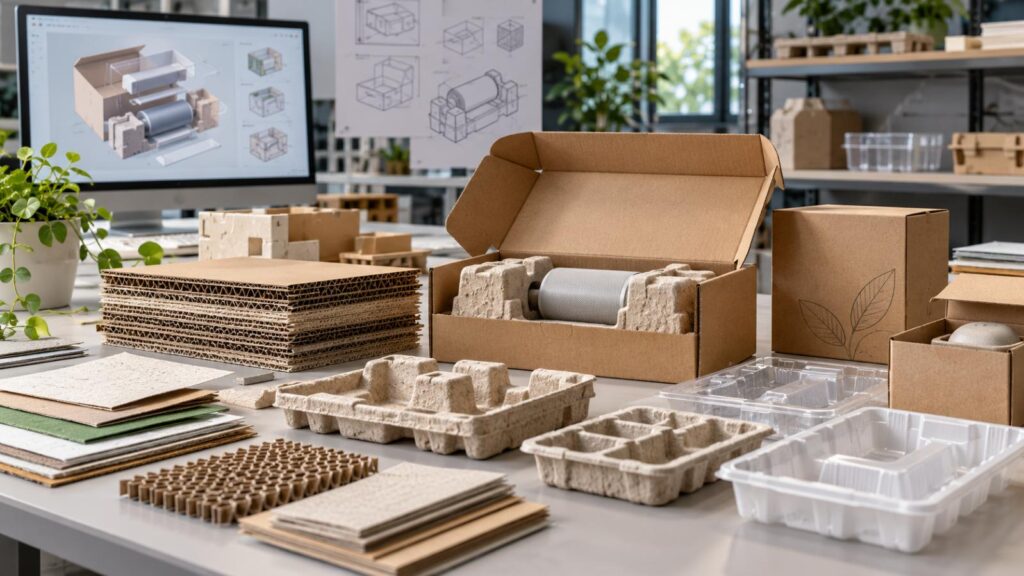
At LKK Design, we consider packaging as an extension of product design. Therefore, our engineers develop packaging that incorporates product geometry and mechanical vulnerability, and ensures that the packaging accounts for product assembly and production tolerances. If packaging does not adequately take into account all of the above considerations, an attractive outer box is of no value to the consumer.
What Do Product Packaging Engineering Services Include?
Product Packaging Engineering Services consists of a complete packaging design process from defining the product dimensions to the completion of production-ready plans. Below are the major steps in this process.
• Defining Requirements: These include defining product dimensions and weights and identifying fragile parts and allowable damage criteria and distribution channels.
• Structural Design: This includes design of cartons and partitions and systems to retain the product.
• Materials Engineering: This includes assessing the performance of different materials as cushioning systems and evaluating the resistance of different materials to moisture.
• Prototyping: This includes evaluating the packaging system to assess if the system contains the product and if the system aids in assembly of the product.
Preparation for Manufacturing: This includes establishing tooling and packaging system components, and defining and establishing quality assurance check points.
Packaging Engineering Protects Product: Here‘s How
Product protection depends on how energy is transferred from the shipping container to the product. The key variables that influence this transfer are:
• Product Fragility: The shock response that the product can withstand is product-defined either through testing or engineering evaluation.
• Cushion Compression: Cushion materials must be designed and specified to prevent bottoming out.
• Contact Area: Cushion Loading must be evaluated to correspond to the material’s characteristics.
• Internal Clearance: Also known as inter-component clearance, this is the space available to accommodate the fragile components.
• Structural Strength: The package must be able to withstand all environmental conditions and the stresses imposed by shipping, including how other containers will be stacked.
When designing packaging, consider foam density. Load-bearing capacity of a foam increases with density; however, transmitted impact energy is also increased. Thickness, stiffness, and contact area of the cushion must be addressed as a system.
Edge crushes tests (ECT) are performed on the corrugated board to characterize how it compresses along its edge. A Box Compression Test (BCT) is performed to evaluate the overall completed package. Neither of these tests, however, guarantees adequate performance during actual warehouse conditions.
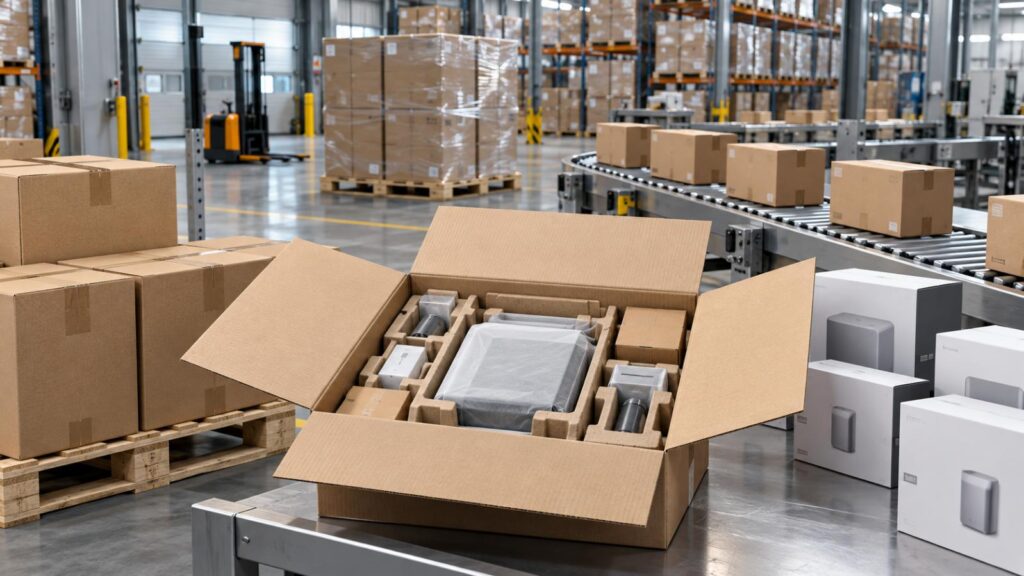
Material Selection for Different Packaging Applications
| Material | Engineering Advantages | Limitations | Typical Applications |
| Corrugated Board | Lightweight, foldable, customizable | Moisture sensitivity, reduced strength under prolonged loading | Shipping cartons |
| EPE Foam | Resilient cushioning, low mass | Recycling limitations, cushioning characteristics vary by grade | Electronic equipment |
| Molded Pulp | Custom-shaped fiber structures | Moisture absorption, dimensional variability | Consumer products |
| PET Trays | Repeatable formed geometry, precise positioning | Tooling investment, recycling considerations | Retail and electronic packaging |
At LKK Design, our material selection approach considers protection, geometry, tooling, environmental requirements, and production volume together.
How Can Product Packaging Engineering Services Reduce Total Packaging Costs?
Packaging Cost vs. Lifecycle Cost
The cost of the material is only one part of the total packaging cost. The total cost per unit is as follows:
Total Cost per Unit = Material Cost + Conversion Cost + Packing Labor + Logistics Cost + Tooling Amortization + Expected Damage Cost
The major trade-offs include:
• Right-Sizing: Corrugated boxes of a smaller size reduces total material consumption, and also reduces dimensional weight. If there is not sufficient clearance, the risk of impact damage during transit may also increase.
• Custom vs. Standard Packaging: Standard packages are always cheaper. Custom packaging (e.g. using trays and foams) reduces waste and/or assembly time at the proper production volume.
• Packing Operations: Complex packing operations (i.e. a multi-step fold and insert) increase overall labor cost.
• Damage: Using cheaper packing materials may lead to a higher damage rate, which will increase the total cost of the shipment.
Sustainability Without Compromising Protection
Sustainable packaging engineering requires more than just replacing a materials of concern.
In evaluating packaging alternatives, consider:
• Material sourcing and recycled content
• Weight and volume of packaging
• Expected damage rate
• Manufacturing energy and tools
• Available collection and recycling infrastructure
A package of less material does not guarantee less environmental impact if the protection of the package results in increased damage to the product and therefore increases the environmental impact of the manufacturing and distribution.
How Are Packaging Designs Validated Before Mass Production?
Packaging engineering services should set acceptance criteria before a test is performed to ensure the test is measurable.
| Test Method | Primary Engineering Objective |
| Drop Testing | Identify impact damage and cushioning failure |
| Random Vibration Testing | Evaluate abrasion, movement, and component loosening |
| Compression Testing | Assess container deformation and stacking resistance |
| Climate Conditioning | Examine temperature and humidity effects |
| Fit and Assembly Testing | Verify clearances, positioning, and packing repeatability |
ISTA 1-Series procedures provide integrity screening, while suitable ISTA 3-Series procedures simulate defined distribution hazards. ISTA 3A addresses individual parcel shipments; ISTA 3B is designed for less-than-truckload distribution.
The appropriate procedure depends on the actual logistics channel, product configuration, package weight, and applicable customer requirements.
Testing should record:
• Product functionality and cosmetic condition
• Packaging deformation and closure integrity
• Cushion displacement or permanent compression
• Test conditions, sample identification, and failure modes
Passing a laboratory test does not guarantee zero transportation damage. Test results must be interpreted against the specified distribution environment.
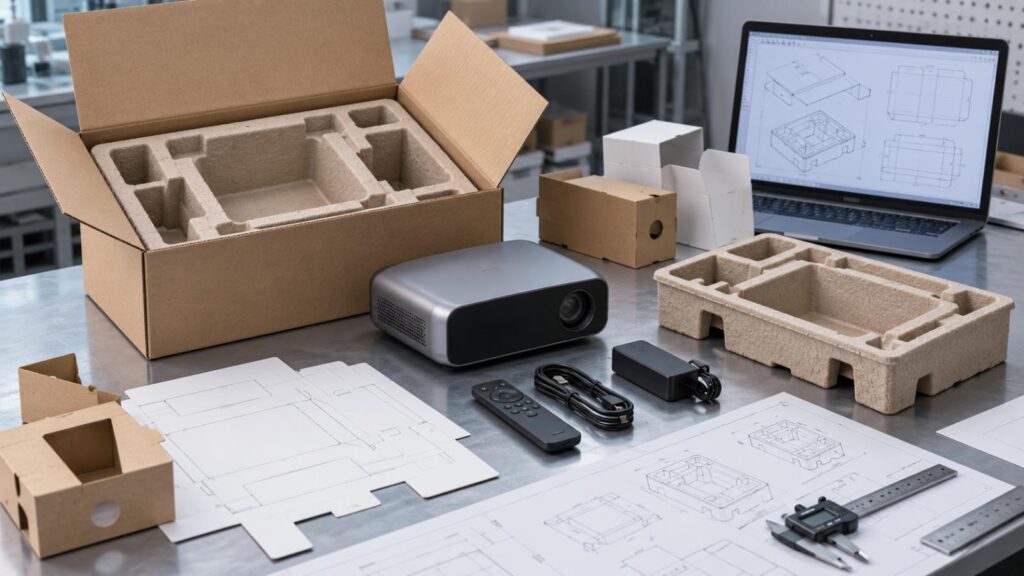
From Packaging Prototype to Production-Ready Design
While a validated prototype has a high level of assurance for functionality, there are still numerous considerations regarding manufacturability.
In the context of packaging, these considerations include dieline accuracy, material conversion, forming, and tolerances, tooling, and packing.
At LKK Design, we integrate packaging development and manufacturing to efficiently identify potential challenges of production. This is done before the production specifications are finalized.
Critical packaging specifications for production include:
• Approved packaging drawings and dielines, with an established bill of material.
• Material grades and thicknesses, as well as their tolerances
• Instructions for assembly and sealing of the cartons.
• How incoming material is to be inspected, and the quality standards for production.
Changes to the production tooling, as well as changes in product weight, can invalidate the testing. These should be assessed for their potential to require additional validation.
How to Choose a Product Packaging Engineering Services Partner
Potential packaging engineering services partners should be evaluated on the basis of their technical deliverables rather than their price.
| Critical Factors | Key Procurement Questions |
| Engineering Capability | Can the supplier design around product fragility and geometry? |
| Material Expertise | Can alternatives be compared using measurable properties? |
| Testing Resources | Are appropriate protocols and acceptance criteria defined? |
| Manufacturing Support | Are tooling, tolerances and assembly considered? |
| Quality Management | How are changes in material and batch consistency controlled? |
| Cost Transparency | Are tooling, logistics and damage costs considered? |
An engineering services partner should help make traceable decisions by integrating design requirements, testing, and manufacturing.
LKK Design’s Product Packaging Engineering Services incorporates structural packaging design and material and prototype development. We help assess package transportation and coordinate package manufacturing. We help consumer electronic companies and hardware startups mitigate the financial risks of packaging before committing to full scale product production.
Discuss with LKK Design engineering team to gain a better understanding of packaging solutions that work for your product, mode of distribution and manufacturing.
FAQs
Q1. What Product Packaging Engineering Services Does LKK Design Offer?
LKK Design provides structural packaging design, material selection, prototyping, product-fit verification, transportation testing support, and manufacturing coordination.
Q2. Can LKK Design Develop Custom Protective Packaging?
Yes. LKK Design develops packaging structures around product dimensions, weight, fragility, cushioning requirements, and distribution conditions.
Q3. What Packaging Materials Can LKK Design Evaluate?
LKK Design evaluates corrugated board, protective foam, molded fiber, plastic trays, and other packaging materials based on protection, cost, and manufacturing requirements.
Q4. Does LKK Design Provide Packaging Prototyping Services?
Yes. LKK Design supports packaging prototypes, structural mock-ups, dimensional verification, and product-fit testing before production tooling is finalized.
Q5. Can LKK Design Support ISTA Packaging Testing?
Yes. LKK Design supports transportation validation, including drop, vibration, and compression testing, with third-party laboratory coordination when required.
Contact Us



- 20+ Design Industries Serviced
- 200+ Product Categories
- 1,000+ Industry Leaders Served
- 10,000+ Products Successfully Launched

Founder and Chairman of LKK Design Group
Ready to get started? Connect with us today!
 Talk to Our Team