
 Home /
Electronic Product Design and Development for Wearables


Electronic Product Design and Development for wearables is a constrained system-design exercise. A smaller enclosure limits battery energy and antenna clearance; additional sensing and wireless functions increase current demand and heat. For smart rings, fitness trackers, and health-monitoring devices, battery life, dimensional limits, RF performance, and skin-contact temperature must be specified together—not corrected independently after prototyping.
Define a Measurable Wearable Architecture
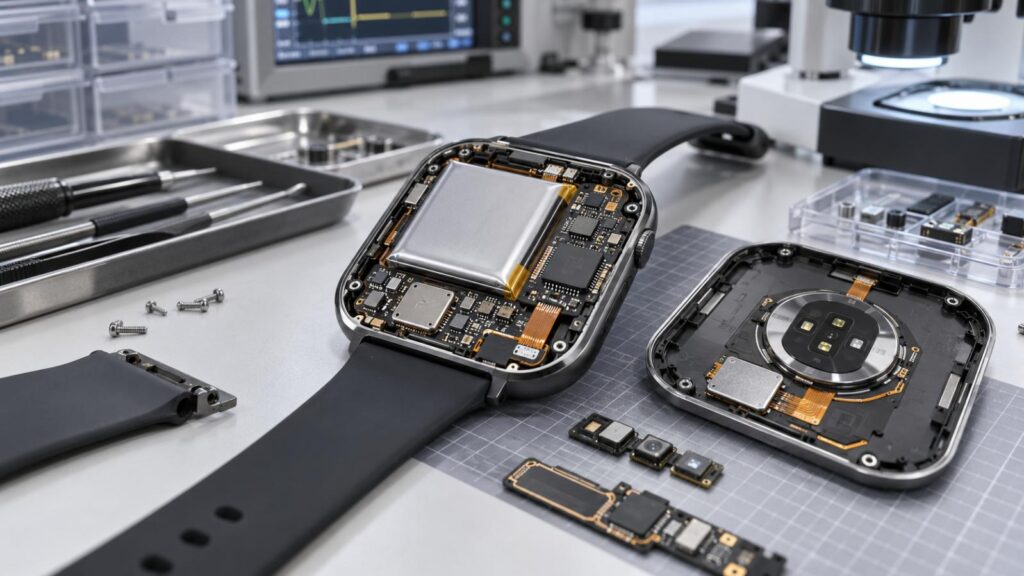
Before schematic capture, the product requirements document should define operating modes, target runtime, dimensions, weight, charging time, sensing accuracy, environmental exposure, and destination markets. Translate these into an architecture covering the MCU/SoC, sensors, radio, PMIC, battery, firmware, and enclosure.
At LKK Design, our electronics, embedded-firmware, and mechanical-engineering services address these connected decisions. Design reviews should resolve three early conflicts: battery volume versus runtime, antenna placement versus enclosure materials, and heat spreading versus wearer comfort.
Battery Life in Electronic Product Design and Development
Calculate Energy from Operating States
A useful power budget records current × duty cycle for sensing, processing, radio transmission, display, and sleep states:
Average current ≈ Σ (state current × fraction of time in that state).
Estimated runtime (hours) ≈ usable battery capacity (mAh) / average current (mA).
There are numerous factors outside of our control that can affect how long your device will operate from a single charge. These include: PMIC conversion losses, Voltage cutoff, Temperature, Cell Aging, and Peak-current capability. Energy used during a usage cycle varies. To properly gauge energy use, you will need to measure the actual current used during usage cycles.
• MCU and Sensors: Deep Sleep and Interrupt Driven Sampling reduce idle drain. Lower sampling rates must still capture the required events with the fidelity necessary to ensure the correct result.
• Connectivity: Latency and Energy Efficiency in Bluetooth low Energy are impacted by advertising, connection intervals, transmission power and packet batching. Wi-Fi is also higher throughput but requires a different power budget.
• Battery: Rechargeable Li-Ion Polymer cells require charge management, protection and thermal sensing. Primary Cells are limited by pulse loads and may require replacement.
• Charging: Charging current and time-to-charge are impacted by the heat buildup in the case and battery datasheet limits.
Miniaturization: PCB Layout, RF, and Assembly
Select the Board Stack-up for the Actual Geometry
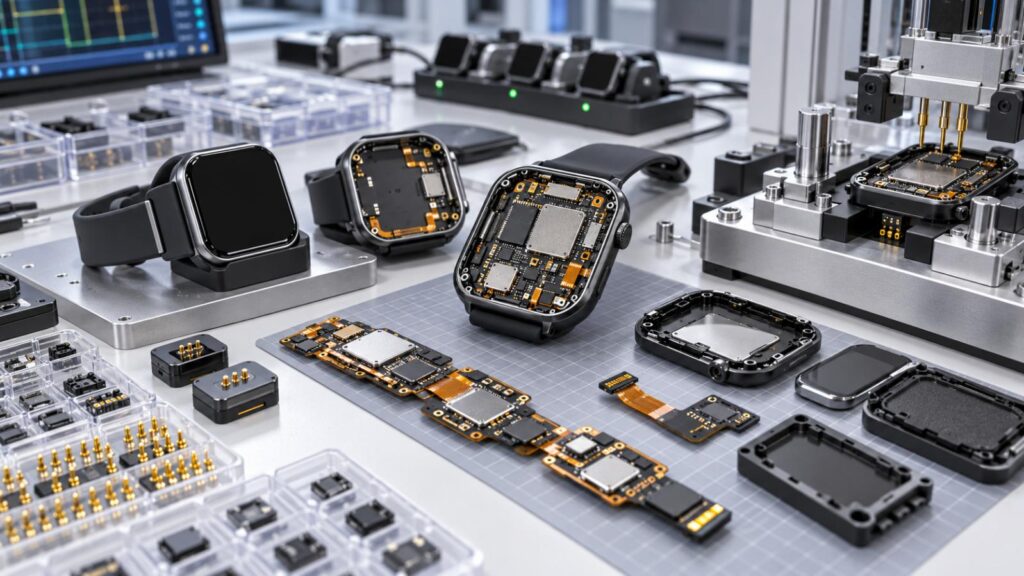
A dense board is not automatically a manufacturable board. Component height, battery clearance, flex bend radius, solder-joint accessibility, sealing features, and test-point access must fit the mechanical stack-up.
| Approach | Engineering advantage | Limitation to verify |
| Rigid PCB | Mature assembly and inspection | Board shape and connector space |
| Flexible PCB | Fits curved sensor or interconnect paths | Bend fatigue and strain relief |
| Rigid-flex PCB | Reduces board-to-board connectors | Fabrication cost, yield, rework |
SoC/SiP integration decreases form factor, but increases thermal problems and restricts design flex. On body testing is essential. Skin, metals, and batteries all affect antenna impedance and radiation. Be mindful of tolerance stackups for design for manufacturing/assembly (DFM/DFA).
Control Heat at the Skin Interface
Thermal Design: Separate Junction, Battery and Contact Temperatures
There are transient thermal loads from bursting MCUs and regulators and steady state loads from displays and charging and radiating components. Thermal simulations can help with early placement of components. Final validation must be done by measuring in realistic use cases and environments.
• Heat must flow: Use of graphite spreaders or heat pipes can move heat away from hot spots.
• Isolate sensitive areas: Mechanical and thermal isolation helps steer heat away from the battery and the wearer’s skin, though it cannot remove all heat
• Reduce source: Depending on firmware calibration, a processor can be put into a deeper sleep state to reduce its thermal load and activity.
• Temperatures effect comfort: Calibrate sensors to account for thermal drift. This helps maintain measurement integrity.
Do not treat a safe chip junction temperature as proof of safe skin contact. Evaluate surface materials, contact duration, battery temperature limits, and the applicable product-safety requirements separately.
Compare Technical Choices Against Product Requirements
| Decision | Main selection criteria | Validation evidence |
| BLE vs. Wi-Fi | Data volume, latency, power budget | Current profiles, RF tests |
| Local vs. cloud processing | Compute heat, radio cost, privacy | Duty-cycle and thermal tests |
| Rechargeable vs. primary cell | Volume, charging, pulse current | Discharge and protection tests |
| Rigid vs. rigid-flex | Geometry, connector count, yield | Assembly trial, bend reliability |
| Passive cooling vs. throttling | Sustained load, skin comfort | Worst-case temperature mapping |
Electronic Product Design and Development decisions must also account for BOM cost, component lifecycle, alternate suppliers, repairability, and expected production yield—not just prototype performance.
Verification, Compliance, and Production Release
Use EVT, DVT, and PVT as Evidence Gates
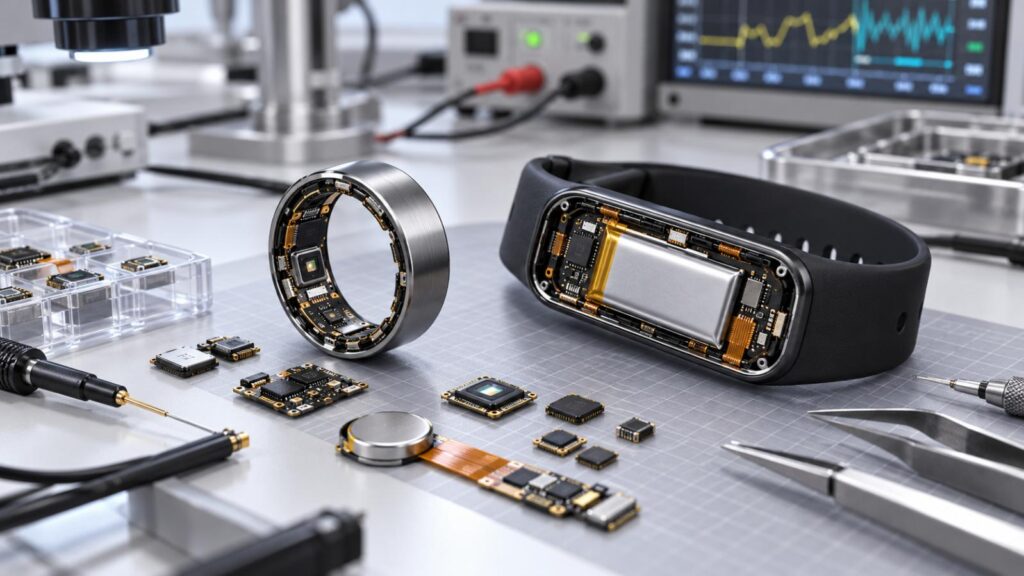
Assess functional architecture, power budget and RF performance. Identify RF hotspots.
• EVT: Assess functional architecture, power budget, and RF performance. Identify potential RF hotspots and integration issues.
• DVT: Evaluate run times and usage. Conduct body reception tests. Assess accuracy of sensing and sealing. Access exposure to the environment. Assess thermal cycling. Evaluate reliability.
• PVT: Assess the yield of the process. Perform final function and electrical tests. Perform first article inspection. Assess tolerance, variation and drift. Validate calibration and coverage of fixtures.
IEC 62133-2 requires the assessment of rechargeable Lithium batteries only. IEC 62368-1 requires the assessment of certain ICT products only. Depending on the Sales Market and Medical Use claims, other regulations may also apply. Check applicability and not assume a single standard applies to all wearables.
When considering an Electronic Product Design and Development partner, verify the partner is able to provide firmware source codes, design PCBs as per requirements, perform power and thermal testing, and release the product as per documented release criteria.
LKK Design is able to offer PCB and embedded design services, as well as industrial, mechanical, and system design, prototyping and manufacturing services. For your wearable concept, explore our Electronic Product Design and Development services.
FAQs
Q1. Does LKK Design provide Electronic Product Design and Development for wearable devices?
Yes. LKK Design offers electronics engineering, PCB design, embedded firmware, mechanical design, prototyping, and manufacturing support for smart hardware development.
Q2. How does LKK Design approach battery life optimization for wearable electronics?
We use low-power hardware architecture, firmware optimization, power-budget analysis, and component selection to address battery runtime requirements.
Q3. Can LKK Design support miniaturized PCB design for wearable products?
Yes. Our PCB engineering services address compact layouts, component integration, signal integrity, and manufacturing constraints.
Q4. How does LKK Design address thermal management in wearable electronics?
We incorporate thermal simulation, component placement, PCB layout considerations, and engineering validation to identify and manage heat-related design risks.
Q5. Does LKK Design support Bluetooth and IoT connectivity development?
Yes. Our embedded engineering capabilities include Bluetooth, Wi-Fi, NB-IoT, firmware development, and IoT system integration.
Contact Us



- 20+ Design Industries Serviced
- 200+ Product Categories
- 1,000+ Industry Leaders Served
- 10,000+ Products Successfully Launched

Founder and Chairman of LKK Design Group
Ready to get started? Connect with us today!
 Talk to Our Team