
 Home /
Machining Prototype Materials Selection Guide: Performance, Precision, and Cost Considerations


A selection guide that covers the different behavioral aspects of materials used in machined prototypes enables better identification of the limitations of manufacture. When selecting materials, machining limitations and the effects on the manufacturing process and the surfaces and features formed must be considered. The shape and form of gears and threads also must be taken into account.
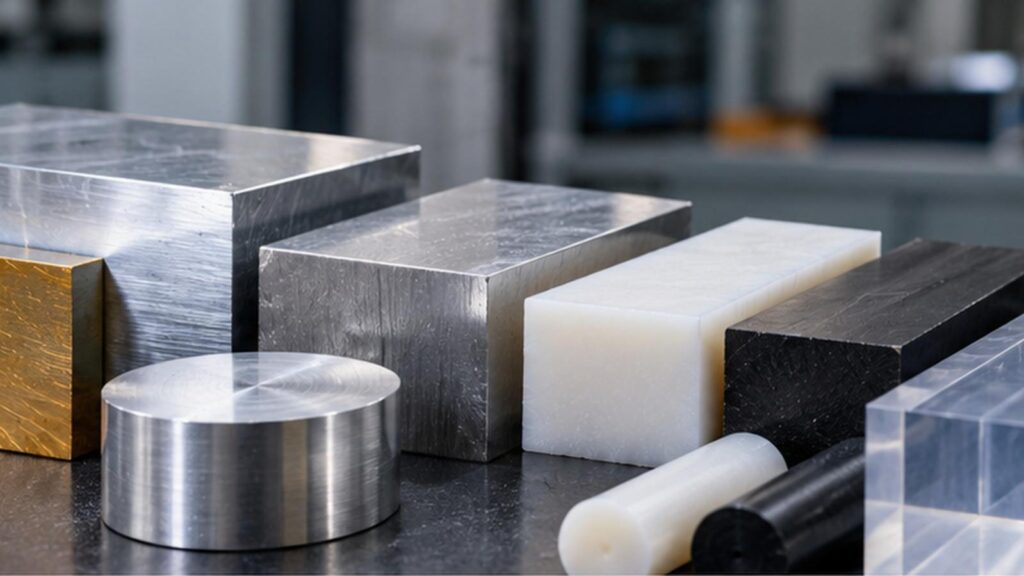
The materials we select at LKK Design must be in synergy with the mechanical design, machining, and Manufacturability considerations to distinguish between materials suitable for early prototype validation and those that are representative of production part testing.
1. Identify Prototype Requirements, Then Select Materials
Prioritize Material Performance according to Prototype Stage
To select a material, it is necessary to understand what the prototype is intended to demonstrate or prove. The level of performance varies with the stage of the prototype.
| Prototype Stage | Validation Priority |
| Appearance prototype | Visual design |
| Fit-check prototype | Clearances |
| Functional prototype | loads, movement, durability |
| Environmental prototype | Operating conditions |
| Pre-production prototype | Manufacturing |
Once the required performance of the material is determined, the four following considerations must be evaluated.
• Mechanical: Strength, stiffness, fatigue, and wear.
• Thermal: Operating temperatures.
• Environmental: Corrosion and moisture.
• Manufacturability: Wall thickness and tolerances, surface finish, and machining complexity.
For instance, an ABS enclosure can prove assembly clearance in a functional prototype, but its inability to withstand loads compared to an aluminum housing can not represent the production housing.
2. Compare CNC Prototype Materials by Engineering Performance
An effective Machining Prototype Materials Selection Guide distinguishes metal alloys and engineering plastics according to their actual operating requirements.
| Material | Engineering Advantages | Typical Applications | Selection Limitations |
| Aluminum 6061 | Good machinability, balanced strength, corrosion resistance | Housings, brackets, fixtures | Lower strength than 7075 |
| Aluminum 7075 | High strength-to-weight ratio | Structural components | Higher cost, corrosion considerations |
| Stainless Steel 304 | General corrosion resistance, toughness | Industrial assemblies | Work hardening, longer machining cycles |
| Stainless Steel 316 | Better chloride resistance in many environments | Marine and chemical-exposure parts | Higher material and machining cost |
| ABS | Easy machining, economical | Enclosures, appearance models | Limited temperature resistance |
| POM | Low friction, good dimensional stability | Gears, sliding mechanisms | Poor adhesive bonding |
| Polycarbonate (PC) | High impact resistance | Protective covers | Stress cracking, machining heat |
| Nylon (PA) | Toughness, wear resistance | Bushings, mechanical components | Moisture-dependent dimensional changes |
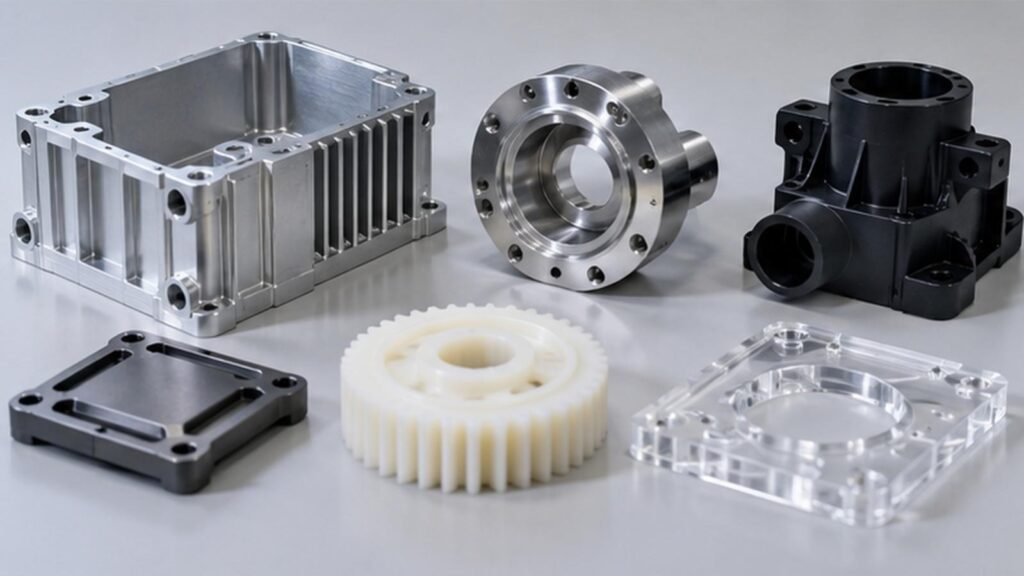
Key Material Trade-offs
• 6061 vs. 7075 Aluminum:7075 Aluminum is stronger, but for structural prototypes, 6061 Aluminum is better for a few reasons. One, 7075 Aluminum does not have a higher stiffness than 6061 Aluminum. Also, their elastic moduli are similar, so stiffness is not a differentiator. 6061 is preferred for structural prototypes because it costs less and machines more easily; 7075 is reserved for high-stress parts where its higher yield strength matters.
• 304 vs. 316 Stainless Steel: 316 is better in the presence of chloride. Work hardening is present in both. Proper cutting conditions should reduce this.
• ABS vs. PC: ABS is suitable for general-purpose housings where cost and machinability matter; for greater impact resistance (or transparency), PC is the better choice, provided environmental stress cracking is managed.
• POM vs. Nylon: POM is better for dimensional stability to humidity than Nylon, where absorbed moisture may affect wear resistance.
3. Evaluate Machinability, Geometry, and Dimensional Accuracy
How Materials Affect CNC Outcomes
Just because two materials have the same CAD profile, doesn’t mean they will be equivalent in practice.
Important Relationships:
• Stainless Steel machines much differently than aluminum.
• Dimensional Changes: Cyanate esters and PEEK/PPS are sensitive to thermal deformations. Thermo-softening of engineering plastics can occur from heat exposure or thermal stress from machining.
• Distortion: Heavy material removal can cause walls to distort, especially thin walls.
• Tool Accessibility: Long cycle times can occur from tool deflection in deep pockets and narrow slots, and from small internal radii.
• Workholding: Thin sections distort and deform from clamping forces, especially during long machining and inspection times.
At LKK Design, we can CNC prototype most of your parts to the following requirements: dimensions within +/- 0.05 mm and surface finishes of Ra ≤ 0.8 μm. The actual limits will depend on the material, geometry, feature sizes, and measurement conditions.
Considerations for Tolerances and Surface Finishes
Critical dimensions should reference GD&T and functional datums rather than allowing unnecessary tight tolerances to be called out throughout the drawing.
• Surface treatments need to be evaluated as well. For example, anodizing affects dimensions, and thickness of the coating also affects final dimensions.
• Passivation and polishing may also affect dimensions.
• Ra should be specified for functional surfaces that need to be machined to the required finish. Surface roughness does not guarantee flatness.
4. Calculate the True Cost of Prototype Materials
A practical Machining Prototype Materials Selection Guide considers total manufacturing cost rather than raw-material price.
Total Cost = Stock Material + Setup + Machining + Tooling Consumption + Finishing + Inspection + Rework
The main cost variables are:
• Material stock size, availability, and material removal ratio.
• Cutting time, tool wear, and required machine setups.
• Wall thickness, complex cavities, and workholding requirements.
• Tight tolerances, finishing operations, and inspection scope.
• Prototype quantity and expected design revisions.
For instance, a lower-priced stainless steel blank may still produce a higher finished-part cost than aluminum because of machining time and tooling requirements.
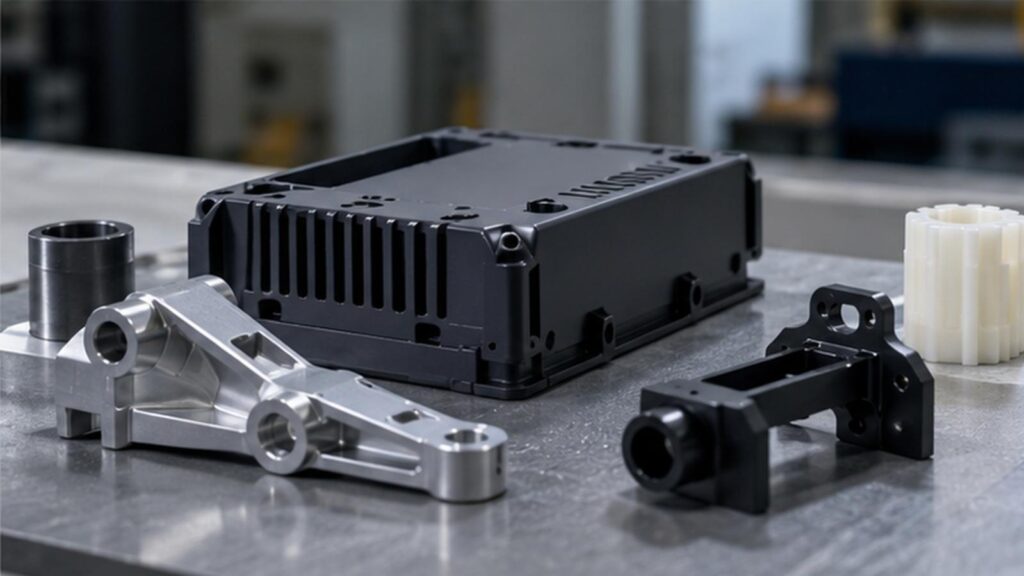
CNC Machining vs. Alternative Prototyping Processes
CNC machining is efficient for rapid creation of test articles using specified stock materials, but:
• 3D printing is better for rapid prototyping of larger, more complex geometries and for prototyping samples with more complex internal geometries, such as honeycombs.
• Vacuum casting is better for multiple samples of similar appearance or assembly (e.g. using a different resin for the samples).
• Rapid tooling is a better alternative for samples that require behavior of an injection-molded part.
The most appropriate process for a prototype is application dependent.
5. Check Material Suitability for Production
DFM Validation and Material Testing
A machined sample, in and of itself, does not validate a material for production.
- Check Material Specifications
Verify the supplier is able to trace the supplied material grade and that the grade is in specification. Additional mechanical properties, such as hardness and/or density, must also be provided. If applicable to the scope of the specification, tensile testing may be performed using ASTM E8/E8M or ASTM D638. Additionally, it may be necessary to verify compliance with applicable regulatory requirements.
- Functional Performance Validation
Evaluate the following, depending on application:
• Assembly and fit, tolerance stack up.
• Loading and deformation.
• Wear, fatigue and service life.
• Cycling (Moisture, Temperature).
• Exposure to chemicals.
- Production Compatibility
During the injection molding process, components such as shrinkage, molecular orientation and various forms of stress are introduced. These elements can not be reproduced by CNC machining.
DFM reviews should consider the selection of production materials, thickness of walls, draft angles, features for assembly, process capability and the criteria for inspection.
Buyers should provide CAD files, drawings, critical tolerances, operating conditions, preferred materials, surface finishes, and sample quantities and estimate the volume of production.
6. Material Selection and Production Planning with LKK Design
This Machining Prototype Materials Selection Guide is aimed to establish the relationship between engineering requirements and the evidence of manufacturing.
At LKK Design, mechanical engineering, material selection analysis, CNC prototyping and DFM are integrated. Our development work flow encompasses EVT, DVT and PVT to assess the performance and the aspect of manufacturability at the appropriate stage of the work flow.
Instead of selecting materials based on cost or strength, we assist development teams assess machining constraints and functional verification as well as the production process compatibility.
To find out alternate materials and assess the viability for production from a practical point of view, please contact us for more info.
FAQs
Q1: What CNC prototype materials does LKK Design support?
LKK Design supports CNC prototyping with materials including aluminum alloys, stainless steel, ABS, and POM. Material availability and suitability depend on project requirements.
Q2: How does LKK Design help select prototype materials?
LKK Design evaluates mechanical requirements, operating environments, dimensional tolerances, machinability, and production compatibility during engineering and DFM reviews.
Q3: What CNC machining tolerances can LKK Design achieve?
LKK Design publishes CNC prototype capabilities of approximately ±0.05 mm for suitable parts. Actual tolerances depend on material, component geometry, and inspection conditions.
Q4: Does LKK Design provide surface finishing for CNC prototypes?
Yes. LKK Design offers surface finishing services and publishes surface roughness capability of Ra ≤0.8 μm for suitable CNC applications. Specific finishes require project evaluation.
Q5: How does LKK Design control prototype manufacturing costs?
LKK Design considers material selection, machining complexity, setups, tolerances, surface treatments, and production quantity during DFM and cost evaluation.
Contact Us



- 20+ Design Industries Serviced
- 200+ Product Categories
- 1,000+ Industry Leaders Served
- 10,000+ Products Successfully Launched

Founder and Chairman of LKK Design Group
Ready to get started? Connect with us today!
 Talk to Our Team