
 Home /
Low Volume Manufacturing vs Mass Production: Cost, Quality, and Scaling Decisions


Low-volume manufacturing and mass production each contain a balance of risks and rewards related to tools, cost, flexibility and risk. Lower quoted unit costs usually do not align to lower total manufacturing costs, particularly when demand is speculative.
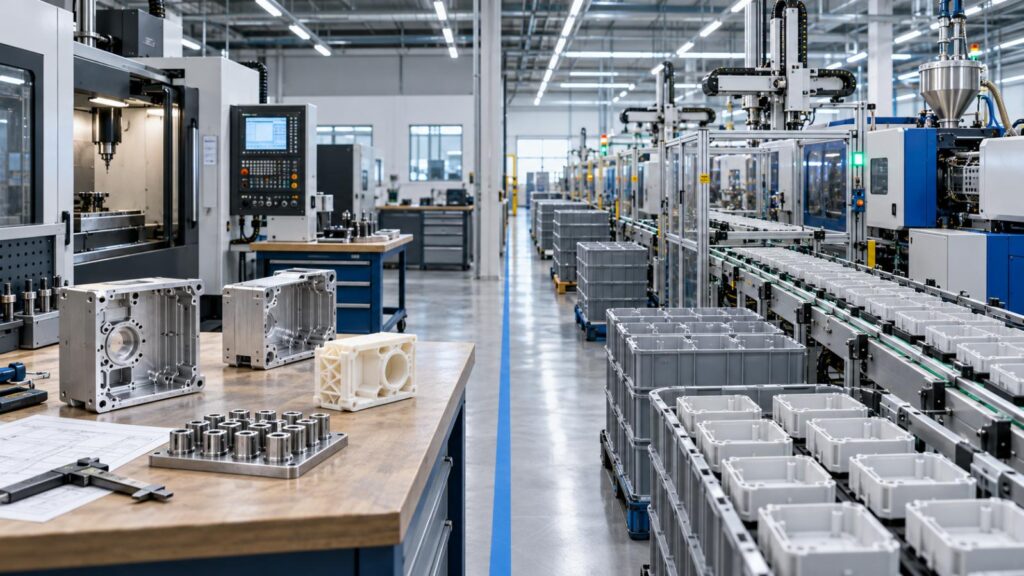
At LKK Design we approach decisions around production volume using design for manufacturing, material assessment, tooling strategy and validation of production processes. The goal is to identify a manufacturing process that will support the current order requirements and volume and anticipated future requirements.
1. Low Volume Manufacturing vs. Mass Production: Key Technical Differences
Low volume manufacturing includes processes such as producing relatively low volumes, incorporating design changes, or meeting special requirements. Mass production is the high volume repeatable and predictable production of standard items.
| Factor of Evaluation | Low Volume Manufacturing | Mass Production |
| Initial Costs | Less commitment for tools | More investment for tools, automation |
| Unit Economics | More for each unit produced | Less for each unit produced at higher volume |
| Design Flexibility | Easier engineering changes | Changes may require tooling |
| Production Equipment | CNC, rapid tools | Molds, fixtures, automated lines |
| Quality | Flexible inspection | Process monitoring |
| Inventory Level | Less committed inventory | More exposed to excess inventory |
| Situations | Pilot runs, special, custom | Stable, repetitive product demand |
It can be difficult to set a cutoff point for low volume manufacturing and high volume manufacturing. The dividing line is usually economic rather than quantitative. This is determined by the processes and tools used to produce the part.
2. Cost Analysis for Manufacturing: When Does Mass Production Become Cheaper?
Fixed and Variable Costs
When considering Low Volume Manufacturing and Mass Production, the procurement team should look at total costs rather than unit costs when making the decision of whether to produce the part in-house or outsource it.
Total Cost of Manufacturing = Fixed Cost + (Number of Units Produced x Variable Unit Cost) + Other Costs
Fixed costs are Non-recurring Engineering costs (NRE), tooling costs and the cost of setting up the equipment for the production run. Variable costs are incurred when consumables (i.e. material, labor, and other consumables) are used in the production process.
Additional costs may include scrap, freight, inspection and engineering change orders.
| Cost Parameter | Low Volume | Mass Production |
| Initial Tooling/Set Up | $3,000 | $18,000 |
| Variable Unit Cost | $12 | $5 |
| Cost at 1,000 Units | $15,000 | $23,000 |
| Cost at 5,000 Units | $63,000 | $43,000 |
The break-even quantity is (18,000 – 3,000) / (12 – 5) ≈ 2,143 units
From the example above, Mass Production would be more economical than Low Volume Manufacturing for quantities over 2,143 units.
The calculation above is simplified. In reality, numerous other factors related to financing, defects, inventory and logistics should be taken into account. Moreover, a buyer should be considering forecast uncertainty when evaluating tooling.
Figures are illustrative and not actual LKK Design costs.
3. Manufacturing Processes, Materials and Tooling Selection
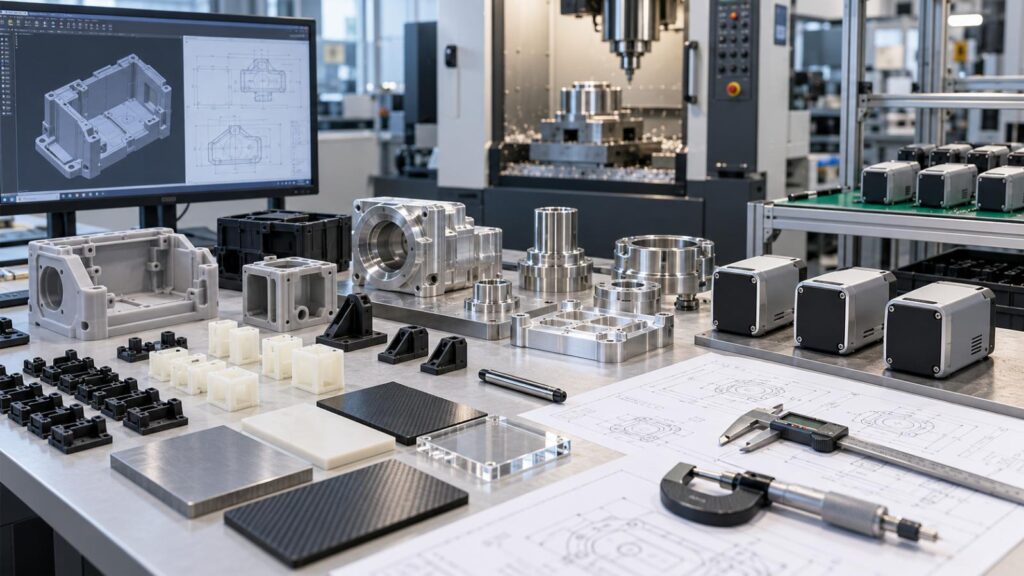
Integration of manufacturing technology and other relevant processes are critical for product development, i.e. achieving optimal product attributes and assuring that product is manufacturable at the required economics.
| Manufacturing Process | Typical Application | Technical Consideration |
| CNC Machining | Precision components, small batch production | Machining time, material wastage, tolerances |
| 3D Printing | Functional prototypes, complex geometries | Build orientation, anisotropy, throughput |
| Vacuum Casting | Small batches of simple plastic parts | Life of a silicone mold, material equivalence |
| Injection Molding | Thousands of identical plastic components | Mold investment, cycle time, shrinkage |
| Sheet Metal Fabrication | Large enclosures | Dimensional control, bend radius |
| SMT Assembly | Electronics | Bill of Material, integration |
Tooling Strategy and Design Compatibility
In low volume production flexible tooling and aluminum bridge molds can reduce upfront costs. High production steel molds can support longer production runs, but are limited by the design of the mold, materials used, and the conditions of use.
Prior to switching between processes the following must be taken into account:
• Dimensional Control: Requirements and tolerance stack-ups, assembly interfaces.
• Material Equivalence: Strength, thermal behavior, surface properties, and long term stability.
• Injection Molding DFM: Thickness, draft, shrinkage, and cooling.
• Tooling Economics: Mold cavities, cycle time, and expected tool life.
A CNC-machined plastic prototype does not automatically reproduce the shrinkage, internal stresses, or mechanical behavior of an injection-molded component.
At LKK Design, our manufacturing services connect prototyping, tooling development, CNC machining, injection molding, sheet metal fabrication, and electronics assembly with product engineering decisions.
4. Quality, Consistency, Lead Time, Supply Chain Risks
Mass production allows for process to be monitored for consistency, but consistency is determined by a process that is validated, regardless of production quantity.
There are other methods to support quality.
• FAI: First Article Inspection checks the initial manufactured parts against drawings.
• SPC: If there is process variation, Statistical Process Control (SPC) detects process deviations and enables teams to implement permanent corrective actions to prevent recurrence.. Cpk is the assessment to determine if the process is capable of meeting the specification limits.
• PFMEA: Determines risks in the manufacturing process.
• Traceability: Batch and component records are useful during an investigation and corrective action.
Applicable requirements may include ISO 9001, IPC-A-610 (for the electronic assembly industry), among others. Specific controls may vary depending on the product and industry.
Lead Time, MOQ, Inventory Risks
Short-order (low-volume) production may eliminate the need for long tooling-development cycles, and a mass production line may reduce lead time for subsequent orders.
There are other considerations besides MOQ, lead time, and inventory. Long-lead time and/or available electronic components, and raw material, as well as the capacity of the supplier, need to be factored in.
Buyers should assess the total lead time of procurement, expected yield, availability of raw materials, safety stock, and engineering change costs.
5. When Should Companies Transition to Mass Production?
Companies should transition to Mass Production when Low Volume Manufacturing processes are documented and proven.
At LKK Design, the framework links the following four stages:
• EVT – Engineering Verification Test
• DVT – Design Verification Test
• PVT – Production Verification Test
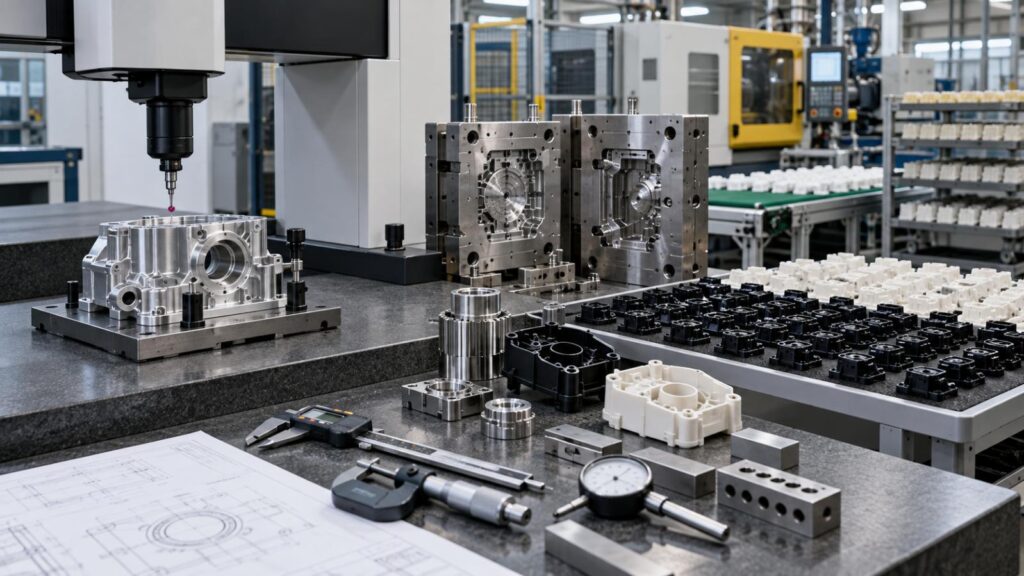
• MP — Mass Production: Meet process controls and production documentation to achieve approved scale.
The Five Indicators of Production Readiness
• Demand Validation: Projected life time sales support tooling investment.
• Design Stability: Major design/engineering changes complete.
• Process Repeatability: Pilot builds meet yield and critical tolerance requirements.
• Supply Chain Readiness: critical components, suppliers, and capacity have been identified.
• Financial Feasibility: Tooling payback, inventory, and working capital are in check.
Introducing mold changes to enable design verification for mass production can result in mold rework, defective assemblies and component obsolescence.
For high levels of product customization, and especially in situations of high level product variety, and unstable demand, low volume production may be a better strategy.
6. Choosing a Manufacturing Partner for Different Production Volumes
Buyers must evaluate a manufacturer’s ability to repeatably produce the designed component/product.
We evaluate a suppliers’ ability to manufacture a design by assessing the following:
• DFM: Feasibility to manufacture given dimensions, materials and tolerances.
• Tooling: Ownership and costs associated with mold tooling.
• Production Validation: Pilot run yield and inspection.
• Commercial: NRE, MOQ, and Price.
• Ramp-Up: Scalability and production rate.
LKK Design is a single source design and manufacturing partner. Risk assessment and DFM reviews are executed prior to significant tooling investments. This allows us to creatively bridge product design and manufacturing while speeding up time to market for our customers.
FAQs
Q1. Does LKK Design support both low-volume manufacturing and mass production?
Yes. LKK Design supports rapid prototyping, pilot production, tooling development, and contract manufacturing for different production volumes.
Q2. How does LKK Design help determine the right manufacturing volume?
LKK Design evaluates product design, material requirements, tooling investment, manufacturing processes, and projected demand through DFM and production planning.
Q3. What low-volume manufacturing processes does LKK Design offer?
LKK Design offers CNC machining, 3D printing, vacuum casting, sheet metal fabrication, rapid tooling, and related manufacturing services.
Q4. Can LKK Design help reduce tooling costs before mass production?
Yes. LKK Design uses DFM analysis, process selection, and tooling planning to identify potential design modifications and cost-saving opportunities before tooling investment.
Q5. Does LKK Design provide injection molding for different production volumes?
Yes. LKK Design supports injection molding and tooling development. Mold materials, tooling strategies, and production quantities are evaluated according to project requirements.
Contact Us



- 20+ Design Industries Serviced
- 200+ Product Categories
- 1,000+ Industry Leaders Served
- 10,000+ Products Successfully Launched

Founder and Chairman of LKK Design Group
Ready to get started? Connect with us today!
 Talk to Our Team