
 Home /
Packaging Validation Services for Right-Sized Packaging: Engineering Protection Into Smaller Packs


Adjusting carton dimensions changes the clearance for cushioning, method of restraint for the product, and load path. Decreasing carton dimensions may lead to a decrease in production cost and a decrease in material used within those cartons, but may increase the likelihood of impact damage, abrasion, and compression failure.
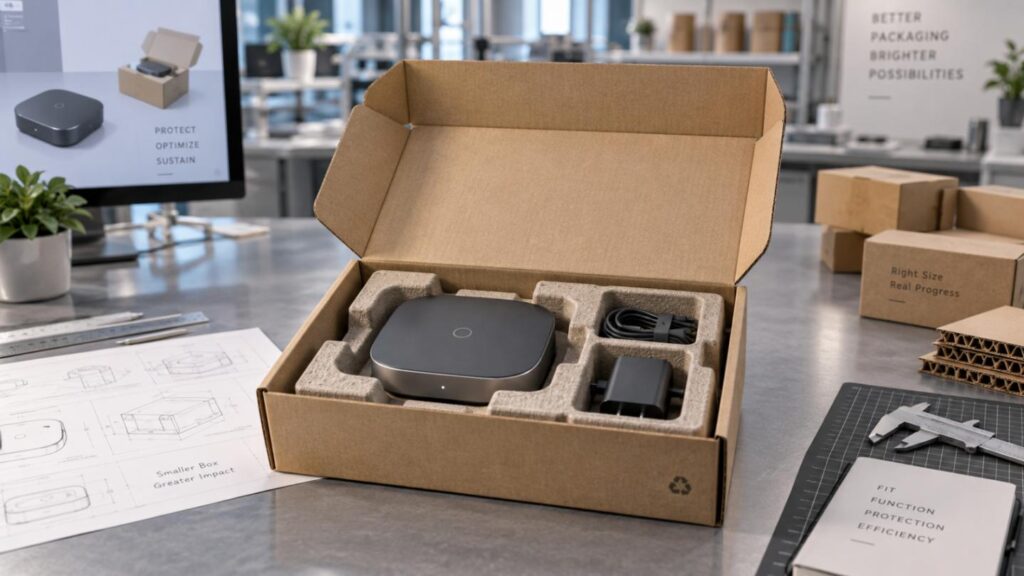
Packaging Validation Services determines if the design changes are still deemed acceptable under the specified distribution conditions. The assessment looks at the complete packed product and the performance criteria agreed upon.
LKK Design has a unique approach to right-sizing by combining structural design and material selection and using a combination of prototyping and transport validation. We take a product’s vulnerability and assess the shipping environment in order to define package dimensions.
1. Define Design Limits Before Volume Reduction
Product Fragility and Dimensional Variation
Packaging Validation Services often requires more specifications than nominal dimensions for the product:
• Mass and center of gravity: Consider asymmetric loading and the potential for rotation during impact.
• Sensitive features: Show the position of displays and/or connectors, unsupported internal structures and cosmetic features.
• Support zones: Indicate where inserts can transfer loads and not damage the product.
• Tolerance Stack-up: Show variation for product, inserts, cartons, assembly, and packaging.
• Accessory restraint: Prevent cables, adapters, and other loose items from striking the product.
A tightly fitted insert may not allow movement but will transmit shock to a fragile housing.
Distribution Exposure
Describe the handling of parcels, transport by pallet, warehouse stacking, climatic exposure, and the potential for returns. Describe the branches of the distribution system in which a palletized shipment is broken down into several parcels.
These inputs define the conditions that Packaging Validation Services must either replicate or represent.
2. Compare Structural Options Against Failure Mechanisms
Right-sizing should compare alternative constructions against a common baseline.
| Design Change | Potential Benefit | Engineering Risk | Required Evidence |
| Smaller outer carton | Reduced shipping volume | Insufficient cushioning travel; product-wall contact | Impact response, clearance, and post-test function |
| Less loose fill | Lower consumption and packing effort | Migration, abrasion, accessory movement | Position retention after vibration |
| Fitted foam or molded-fiber insert | Repeatable restraint and support | Local stress concentration; material-dependent deformation | Fit, support loading, and impact performance |
| Lower board specification | Reduced material weight | Compression loss under stacking or humidity | Conditioned package compression results |
| Shared packaging across SKUs | Fewer packaging variants | Loose fit or excessive preload | Documented coverage of vulnerable configurations |
For cushioning, evaluate material behavior at the actual supported load and thickness. Excessive compression can exhaust the available travel; an overly stiff support may transmit damaging acceleration. Material name or density alone cannot establish protection.
3. Specify a Defensible Validation Protocol
Match the Procedure to the Shipment
Packaging Validation Services should select applicable procedures from the distribution profile and customer requirements. ASTM D4169 provides a framework for evaluating shipping units against distribution hazards; protocol selection still requires project-specific decisions.
Define:
• Procedure and edition, sequence, severity, and conditioning.
• Sample quantities and configuration-selection rationale.
• Inspection points and functional checks.
• Deviations, limitations, and acceptance criteria.
Development screening helps compare concepts. Formal validation should use the approved configuration and production-representative materials.
Connect Exposure to Observable Damage
| Assessment | Technical Focus | Inspection Priority |
| Drop and impact | Cushion compression and load transfer | Cracks, displaced assemblies, functional failures |
| Vibration | Repeated movement and contact | Abrasion, loosening, insert migration |
| Compression and stacking | Carton load-bearing behavior | Buckling, deformation, load reaching the product |
| Climate conditioning | Environmental effects on materials | Strength loss, dimensional changes, adhesive performance |
| Pack-out checks | Assembly repeatability | Incorrect orientation, forced fit, inconsistent closure |
Paperboard properties alone do not establish complete-box performance. Geometry, openings, creases, joints, humidity, and packing configuration also affect behavior.
Preserve the required test sequence: accumulated damage can influence later results.
4. Define Acceptance Before Testing
Packaging Validation Services include measurable acceptance criteria.
1)Product performance
• Checks should be conducted on the product and sample prior to and post testing, and applicable.
• Verify dimension and assembly details
• Investigate internal damage – even if external case appears unruptured
2)Appearance and packaging condition
• Cosmetic limits be agreed, or comparison samples be utilized
• Test closure integrity, retention, label legibility, and safe package handle
• Determine if package deformation is offsetting damage protection
Select configuration based on the failure mode being assessed. Replaced by lighter sku to challenge cushioning, while heavier sku may settle
Reports must identify the configuration of the package and sample being assessed, the packaging material, the revision of the package being assessed, and the conditions under which the assessment was conducted. Determine whether the packaging failure was caused by the packaging material, the packaging design, the packaging method, or a combination of the three prior to retesting and designing a revision to the packaging.
5. Evaluate Savings at the Delivery Level
Packaging Validation Services support savings analyses, which must include the following:
• Material and packaging weight
• Cost of freight, depending on applicable carrier rules and terms of the contract
• Implementation of freight optimization and the utilization of space in warehouses
• Packing time and the equipment needed to repack the product
• Tooling costs
• Expected costs of product damage, replacement, and return
The total of the cost of packaging, packing, freight, tooling, and the cost of the expected failure is the delivered cost.
For example, a reduction of the outer dimensions from 40 × 30 × 20 cm to 36 × 28 × 18 cm shows a volume reduction of 24.4%. The savings will depend upon the carrier’s shipping rules and how the shipment is characterized.
Similarly, a reduction in product weight does not necessarily result in a reduced environmental impact. The impact of damage and replacement shipments on the packaging also needs to be assessed.
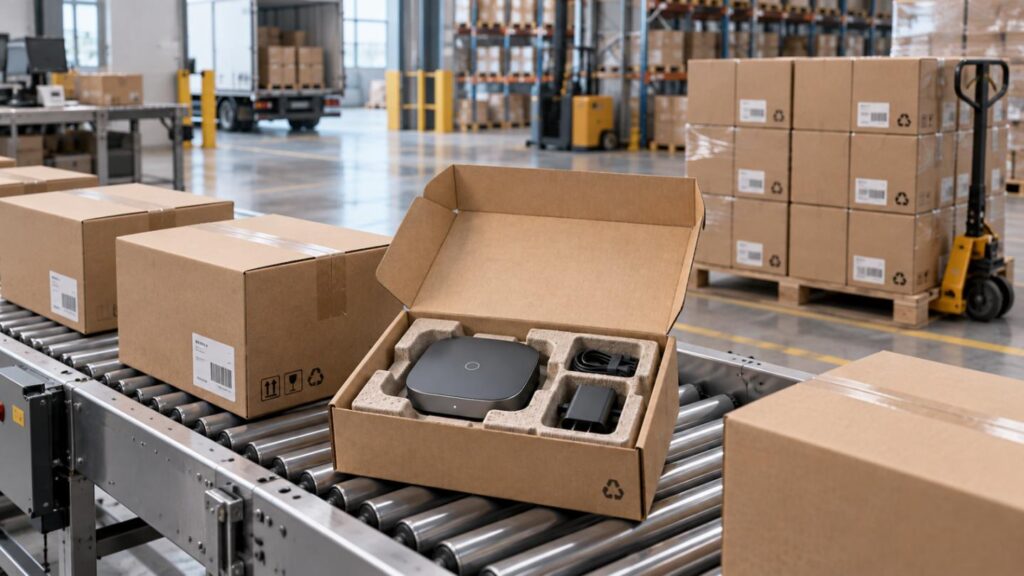
6. Control the Transition to Production
Lock the validated bill of materials (BOM), drawings, specs, tolerances, and sealing instructions. Add checks for insertion dimensions, construction of the carton, position of the product inside the carton with respect to the drawing, and sealing the carton.
Determine if a partial or full revalidation is needed based on changes to suppliers, materials, product weight, tooling, or distribution. Monitor failures of product damage caused by shipping to understand the revision of the packaging and the different failure modes.
Our capabilities interconnect structural design, material selection, 3D modeling, tooling assessment, physical prototyping, and actual-product fit checks with transport testing and coordination of needed third-party laboratories at LKK Design.
To assist teams through a smaller pack assessment, LKK Design draws on product specifications, current packaging, and existing distribution requirements. Packaging Validation Services focuses on packaging changes to improve operational efficiency while still retaining dependable protection of the product.
FAQs
Q1. What Do LKK Design’s Packaging Validation Services Cover?
LKK Design’s packaging capabilities include structural design, material selection, physical prototyping, fit checks, and transportation testing. Testing activities include drop, vibration, compression, stacking, and climate conditioning, with third-party laboratory coordination when required.
Q2. Can LKK Design Help Reduce Packaging Size While Maintaining Product Protection?
LKK Design offers right-sized packaging design and transport validation. The process evaluates carton dimensions, cushioning, product restraint, and distribution conditions. Whether a smaller design provides adequate protection must be established through testing against agreed acceptance criteria.
Q3. What Information Should We Provide Before Starting a Packaging Project With LKK Design?
Provide product dimensions, weight, drawings, fragile features, accessories, and current packaging specifications. Include shipping routes, distribution channels, damage history, order volumes, and cost targets. This information helps define the design constraints and validation scope.
Q4. Which Packaging Materials Can LKK Design Evaluate?
LKK Design offers corrugated board, paperboard, protective foam, molded fiber, plastic trays, and partitions among its packaging options. Selection should account for product fragility, moisture exposure, packing efficiency, tooling requirements, and end-of-life objectives.
Q5. How Does LKK Design Select Packaging Tests for a Project?
LKK Design’s process begins with product specifications and distribution-channel assessment. These inputs help establish relevant testing requirements. Buyers should confirm the applicable protocol, edition, sample configurations, acceptance criteria, and reporting scope before validation begins.
Contact Us



- 20+ Design Industries Serviced
- 200+ Product Categories
- 1,000+ Industry Leaders Served
- 10,000+ Products Successfully Launched

Founder and Chairman of LKK Design Group
Ready to get started? Connect with us today!
 Talk to Our Team