

 Home /
 NPI Manufacturing Engineering Services for Faster Product Launches


NPI Manufacturing Engineering Services: Bridging the Gap between Design and Production
Introducing a new product in the market is an exciting yet one of the most difficult stages of product development. A design can work well during testing, but fail when it goes to production. Parts might be hard to put together, vendors might encounter unforeseen issues, and production expenses can easily spiral out of control.
- This is where NPI manufacturing engineering services are needed. NPI, or New Product Introduction, is the systematic procedure of converting a product idea into a repeatable, scalable, and production-ready solution. It links engineering, manufacturing, quality control, sourcing, and production teams to guarantee a seamless development to full-scale manufacturing.
- In LKKER SCM, manufacturing engineers assist in all phases of product introduction to enable businesses to enhance manufacturability, minimize risks of launching products, and speed up time to market using a systematic engineering process.
The Importance of NPI to Product Success
Numerous product failures are not due to ineffective design. They happen due to the fact that the product was not made ready for manufacturing realities. An effective new product introduction process will make sure that all the factors of production are taken into account prior to launching. Professional new product introduction services have the following benefits:
• Faster product launches
• Reduced manufacturing risks
• Improved product quality
• Better supplier coordination
• Lower production costs
• Enhanced manufacturing efficiency
• Stronger production readiness
• Improved scalability
It is not just about introducing a product. The aim is to introduce a product that can be produced in large quantities at a profit.
Knowing the NPI Process
The NPI process is a systematic approach that takes products from concept to commercialization. A typical NPI workflow consists of: although each project is unique.
1. Product concept evaluation
2. Engineering feasibility review
3. Product design development
4. Prototype builds
5. Engineering validation
6. Design to manufacture reviews
7. Pilot production
8. Production readiness assessment
9. Full-scale manufacturing
Each phase minimizes uncertainty and gives a chance to detect possible production issues prior to their affecting the launch schedule. LKKER SCM incorporates NPI manufacturing engineering services support during the development process, whereby products are not only tested in terms of performance, but also in terms of production feasibility.
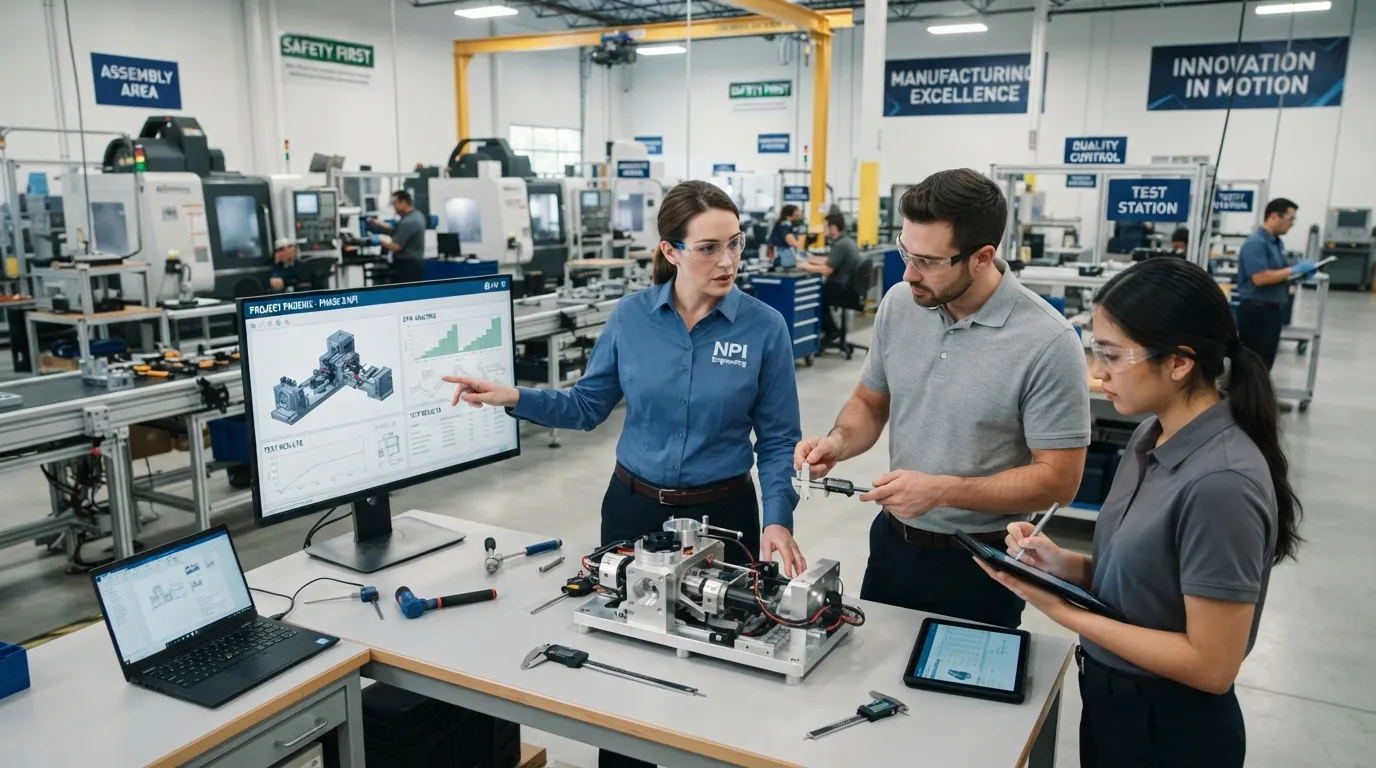
NPI Planning Lays the Groundwork
One of the most significant predictors of project success is strong NPI planning. In the planning stage, the engineering teams define:
• Product requirements
• Manufacturing objectives
• Quality targets
• Cost expectations
• Production timelines
• Supplier strategies
• Validation plans
A good NPI strategy will bring all the stakeholders on the same roadmap. This aids in avoiding misunderstandings among product development teams, suppliers, and manufacturing partners. Even technically sound products may face serious delays in production without appropriate planning.
Development and Production of Products Need to Collaborate
Design engineers and manufacturing engineers work together to create successful products. Engineering product development programs and professional product development services are aimed at striking a balance between innovation and realistic production needs. This may involve:
• Product design reviews
• Manufacturing feasibility analysis
• Engineering validation
• Product optimization
• Design verification
• Product lifecycle management
The most effective new product development initiatives do not view production as an independent phase but take into account manufacturing needs at the outset. This combined methodology helps in a seamless flow of the idea to the manufacturing process and lessens expensive redesign phases.
Prototype to Production
The prototype to production is where most problems arise. A prototype can confirm functionality, but production adds new factors like process capability, supplier consistency, operator training, and equipment performance.
This phase includes:
• Engineering prototypes
• Pilot builds
• Process validation
• Production trials
• Readiness reviews for product launch.
• Manufacturing launch support
Prototype validation is used to ensure that the teams are sure that the products will work under actual production conditions. Pilot production runs also offer useful information on the efficiency of assembly, manufacturing cycle time, rate of defects, and quality performance.
Development of the Manufacturing Process Enhances Efficiency
The product alone is not enough to launch a successful product. The manufacturing process should also be well designed. The development of a manufacturing process is aimed at developing reproducible production systems that can produce quality products at a low cost.
Key areas include:
• Manufacturing process engineering
• Assembly process development
• Production planning
• Factory process engineering
• Production line engineering
• Process validation
• Manufacturing execution
Manufacturing engineers assess processes, assembly lines, tooling needs, and quality control points to enhance overall productivity. This is a systematic process that assists in sustaining long-term manufacturing performance and minimizes operational risks.
Commercialization and Industrialization of Products
Successful industrialization of the product and its introduction into the market is the ultimate goal of any NPI project. This phase is aimed at converting engineering designs into stable manufacturing systems that can sustain commercial demand. Key activities include:
• Product introduction planning
• Production transfer
• Engineering release process
• Manufacturing launch support
• Product deployment
• Product commercialization
A high level of industrialization practices minimizes risks of launch and enhances overall stability in production. Firms that engage professional NPI consultancy services usually enter the market quicker and attain more predictable manufacturing results.
Conclusion
The most successful products are not just well-designed. They are presented in a good manner. The structured NPI manufacturing engineering services methodology minimizes uncertainty, enhances manufacturability, reinforces quality, and ensures a smoother transition into production. Have a new product to plan? Collaborate with LKK SCM to have professional NPI engineering solutions, manufacturing preparedness tests, DFM tests, process development, and production launch solutions to assist in turning innovative ideas into scalable, production-ready products.
Contact Us



- 20+ Design Industries Serviced
- 200+ Product Categories
- 1,000+ Industry Leaders Served
- 10,000+ Products Successfully Launched

Founder and Chairman of LKK Design Group
Ready to get started? Connect with us today!
 Talk to Our Team


