

 Home /
 How to Choose a Product Development Firm for Hardware Startups


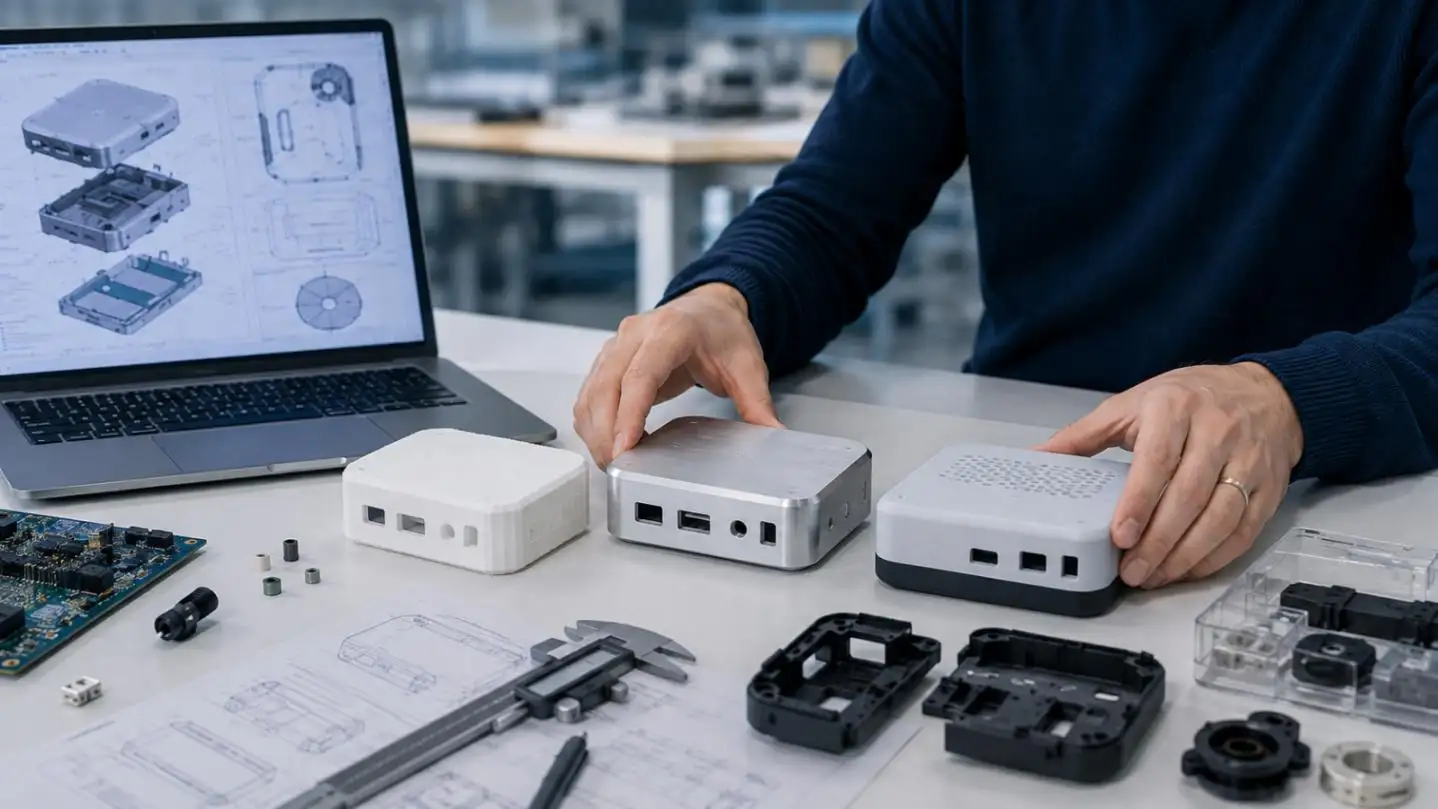

A prototype that powers on is not necessarily ready for tooling. Connector misalignment, molded-part warpage, thermal hotspots, unstable wireless performance and poor production yield often appear only when the design moves from a hand-built unit to repeatable manufacturing.
Understanding How to Choose a Product Development Firm for Hardware Startups therefore requires more than comparing portfolios or hourly rates. The firm must turn uncertain product requirements into measurable engineering specifications—and then prove that the design can be manufactured, certified and maintained.
Start with the Product's Actual Risk Profile
Before requesting quotations, define the conditions that will drive the engineering work:
• Target selling price, BOM ceiling and forecast volume
• Operating temperature, humidity, vibration and drop conditions
• Required ingress protection and expected service life
• Power consumption, battery runtime and thermal limits
• Wireless protocols, antenna constraints and cloud dependencies
• Target markets, certification requirements and launch date
These parameters are interconnected. Reducing enclosure size, for example, may reduce antenna clearance and heatsink area. A thinner wall may lower material cost but increase sink marks, deformation or screw-boss failure.
Demand Evidence at Every Development Gate
A credible development firm should operate through measurable stage gates rather than treating product development as one continuous design exercise.
| Stage | Engineering Question | Required Evidence |
| Concept | Is the product technically and commercially feasible? | PRD, architecture, target cost and risk register |
| EVT | Does the technical architecture work? | Engineering prototypes, test results and issue log |
| DVT | Does the design meet its specifications? | Verification matrix, environmental tests and compliance pretests |
| PVT | Can the factory reproduce the design? | Production tooling, control plan, pilot build and FAI |
| MP | Can quality remain stable at volume? | Yield data, traceability, QC records and change control |
When evaluating How to Choose a Product Development Firm for Hardware Startups, ask to see representative tolerance reports, FEA results, thermal analysis, PCB design reviews, FMEA records and engineering change notices.
For example, if four mating dimensions each carry a tolerance of ±0.10 mm, the worst-case stack reaches ±0.40 mm. An RSS estimate may be approximately ±0.20 mm, but only when the processes are independent and statistically centered. A qualified engineering team identifies functional datums and critical-to-quality dimensions instead of tightening every dimension and unnecessarily increasing cost.
Compare Operating Models, Not Marketing Claims
The right development structure depends on the startup's internal engineering capacity.
| Development Model | Strength | Main Risk | Appropriate Situation |
| Integrated development firm | Fewer mechanical-electronic-firmware interfaces | Capability must be verified in every discipline | Startup lacks a complete internal team |
| Multiple specialist vendors | Access to focused expertise | Version conflicts and unclear responsibility | Strong internal technical management |
| Existing platform customization | Shorter development cycle | Restricted differentiation and IP control | Early market validation |
| Full custom development | Architecture and IP ownership | Higher NRE and longer validation | Product depends on proprietary performance |
| Fixed-price contract | Initial cost visibility | Expensive scope changes | Requirements are stable |
| Milestone contract | Payment follows evidence | Requires precise acceptance criteria | Technically uncertain projects |
Select Prototypes by the Evidence Required
Prototype processes answer different engineering questions. Using the wrong process can create misleading validation results.
Geometry and Ergonomics
SLA, SLS and MJF printing are suitable for rapid form, assembly-space and ergonomic studies. However, printed resin or nylon cannot automatically represent injection-molded shrinkage, fiber orientation, weld-line strength or surface chemistry.
Dimensional and Functional Validation
LKK's prototype CNC machining supports aluminum, stainless steel, ABS and POM, with a stated dimensional tolerance of ±0.05 mm and surface roughness of Ra ≤0.8 μm. This level of physical accuracy allows engineers to evaluate connector alignment, heatsink contact, gasket compression and antenna spacing in representative housings.
Low-Volume System Testing
LKK's silicone vacuum casting supports approximately 50–200 parts in ABS-like, PC-like and transparent materials, as well as elastomers from Shore A 50–90. These quantities are useful for DVT builds, market trials and assembly-process evaluation.
For molded-part evidence, LKK states that rapid tooling supports approximately 50–500 pieces with 3–7-day lead times. Its production injection-molding capability extends to 1,500-ton clamping force, 32-cavity tooling and ±0.05 mm dimensional tolerance. The relevant tolerance must still be evaluated by material, geometry, cavity position and measurement method.
Evaluate DFM, Assembly and Production Control
A development firm should review more than whether a part can be made. It should determine whether the complete product can be assembled repeatedly at the intended takt time and cost.
A practical DFM/DFA review should cover:
• Draft angles, wall uniformity, ribs, bosses and sink-mark risk
• Parting lines, gates, weld lines, sliders and ejection
• Fastener access, assembly sequence and mistake-proofing
• PCB support, connector loading and cable strain relief
• Measurement access and production-test coverage
• Critical dimensions, Gauge R&R preparation and Cpk targets
LKK's tooling process reports ±0.005 mm accuracy for critical mold mating surfaces, with CMM inspection capability of ±0.002 mm. Trial-molding criteria include reported process parameter variation within 2% and dimensional capability targets of Cpk ≥1.67. These figures should be confirmed for the specific tool, material and CTQ rather than treated as universal part tolerances.
Check Installation and Lifecycle Support
The decision process for How to Choose a Product Development Firm for Hardware Startups should extend beyond factory release. The design must accommodate field installation, diagnosis and maintenance.
Confirm whether the firm plans for:
• Power, network, mounting and environmental conditions
• Firmware recovery, encrypted communication and OTA updates
• Diagnostic logs and component traceability
• Replaceable wear parts and repair access
• Production fixtures, functional testing and calibration
• Spare-component and end-of-life sourcing strategies
LKK's embedded capabilities include RTOS and Linux development, driver and BSP development, low-power optimization, Wi-Fi, Bluetooth and NB-IoT integration, security, encryption and OTA management. These capabilities are especially relevant when mechanical, RF and firmware decisions affect the same product behavior.
Verify Compliance Before Design Freeze
Certification requirements depend on product type, intended use and destination market. Potential requirements include CE/RED, FCC, IEC or UL safety standards, RoHS, REACH, IEC 60529 and product-specific medical or automotive requirements.
LKK reports quality-system credentials including ISO 9001, ISO 13485 and IATF 16949, together with support for CE, FCC and RoHS compliance. Buyers should verify certificate validity, scope, site address and applicability. A supplier's management-system certificate does not certify the final product.
Make the Procurement Decision with Technical Evidence
When determining How to Choose a Product Development Firm for Hardware Startups, compare the complete commercial scope: NRE, prototype rounds, tooling, certification, fixtures, unit cost, logistics and third-party testing. Contracts should explicitly define ownership of CAD, drawings, Gerber files, BOMs, firmware source code, test software and tooling.
LKK reports 20+ years in business, 800+ design and R&D professionals, 600+ global design awards, 10,000+ project cases, 5,000+ supply-chain partners and shipments to 30+ countries. Scale and recognition strengthen a candidate profile, but relevant project evidence, transparent deliverables and measurable validation remain the decisive factors.
Hardware startups can begin with a focused feasibility or DFM review from LKK. The quality of its risk analysis, proposed test plan and manufacturing evidence provides a practical basis for deciding whether to proceed into full development.
FAQs
Q1. What product development services does LKK offer?
LKK offers product strategy, design, engineering, prototyping, and mass production.
Q2. Can LKK bring a hardware startup to a production phase?
Definitely. LKK works under the stages of Concept, EVT, DVT, PVT, and production. Documentation prepared under these stages may include product requirements, prototypes, verification reports, production tooling, and quality assurance documentation.
Q3. What is the CNC prototyping accuracy provided by LKK?
LKK mentions that the prototype machining process has a dimensional tolerance of ±0.05 mm and a surface roughness of Ra ≤ 0.8 μm for aluminum, stainless steel, and engineering plastics like ABS and POM.
Q4. Does LKK perform low-volume prototype production?
Yes. LKK's silicone vacuum casting produces about 50 to 200 parts in materials similar to ABS, PC, transparent, and Shore A 50 to 90 hardness. Rapid tooling produces about 50 to 500 parts.
Q5. How does LKK decrease manufacturing risk?
LKK performs DFM and DFA reviews focusing on draft and undercuts, wall thickness, gate, weld lines, fastening, assembly sequence, and tolerance stack-up and critical dimensions.
Contact Us



- 20+ Design Industries Serviced
- 200+ Product Categories
- 1,000+ Industry Leaders Served
- 10,000+ Products Successfully Launched

Founder and Chairman of LKK Design Group
Ready to get started? Connect with us today!
 Talk to Our Team


