
 Home /
 How To Avoid Large Scale Product Quality Issues?



Why Product Validation Is Necessary Before Mass Production
Many companies simply assume that once they have a working prototype / MVP (Minimum Viable Product) and a sufficiently comprehensive Product Requirements Document (PRD), they can go straight to mass production.
However, without proper verification procedures, your product could be recalled in the future, which could cost your company as much as $10 million to over $100 million.
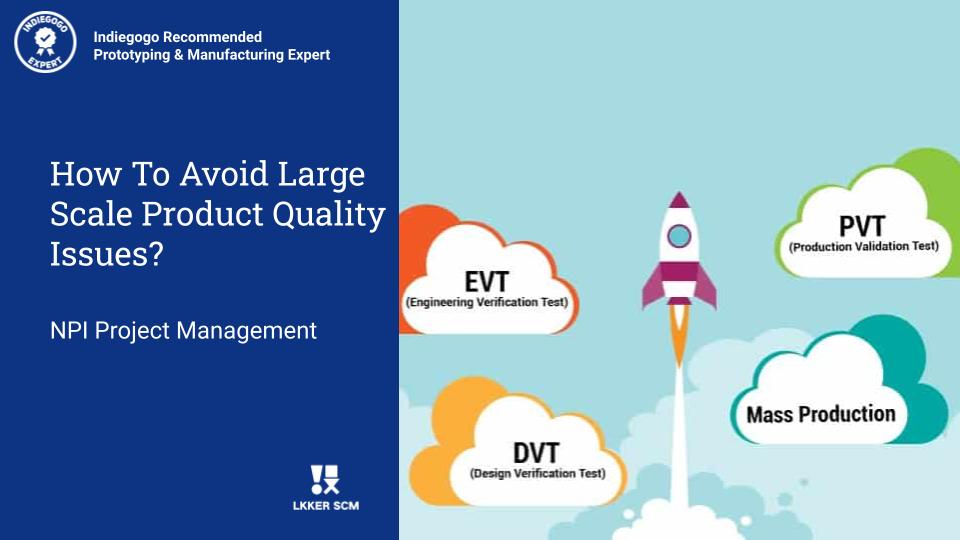
There are three different validation tests that a product needs to perform before it goes into mass production:
- Engineering Validation Test (EVT),
- Design Validation Test (DVT),
- Production Validation Test (PVT).
EVT (Engineering Validation Test)
- Number of EVT (Engineering Validation Test): 10-50
- Duration of EVT (Engineering Validation Test): 4-6 weeks
- Purposes of EVT (Engineering Validation Test): Validate all features and functions are operational.
Many products have just been designed as engineering prototypes, and it is necessary to correct possible design problems one by one, focusing on considering the design integrity and whether any specifications are missing, including functional and safety tests.
EVT (Engineering Validation Test) checks that your product meets all functional, performance, and reliability requirements listed in the PRD (eg 4 hours of battery life, 15Hz - 25kHz frequency response).
The main purpose of EVT (Engineering Validation Test) is to obtain a product sample that meets all expected results and specifications.
DVT (Design Validation Test)
- Number of DVT (Design Validation Test): 50-100 units
- DVT (Design Validation Test) Duration: 4 weeks
- Purposes of DVT (Design Validation Test): Correct the problematic design
In DVT, all designs are complete and the focus is on identifying design issues and making sure all designs are within specification. Verified by R&D and DQA (Design Quality Assurance), the product is basically finalized at this time.
This stage is closely related to the regulatory certification (e.g. RoHS, FCC, UL) for the sale of your product. As such, these tests focus on building the product consistently and reliably.
These prototype units will undergo rigorous stress tests (eg, falls from 1.2m heights, burning, submersion in water, extensive battery testing, etc.) to check their durability, stability, and product longevity.
User groups can also be used to test whether a product meets customer expectations.
PVT (Production Validation Test)
- Number of PVT (Production Validation Test): 1000 Pieces
- PVT (Production Validation Test) Duration: 2 weeks - 2 months
- Purposes of PVT (Production Validation Test): Reach mass production efficiency
At this stage, all product designs have been completed, and the final step is to verify before mass production to ensure that the factory has the means to make the originally designed products according to the standard procedures.
Before entering mass production, it is important to conduct a trial run of the production line to assess quality assurance (QA) and quality control (QC).
PVT (Production Validation Test) is designed to optimize your mass production process, ensuring that the product is produced at the correct quantity, cost, and quality, thus testing the entire mass production speed.
Products produced during these test periods, if they meet all requirements, can be planned for sale to customers and will be considered part of your first production run.
If a fault is found, this will be your last chance to adjust the tooling before mass production.
The Importance of EVT, DVT, and PVT
It takes a lot of time and effort to develop the product, therefore, investing in the EVT (Engineering Validation Test), DVT (Design Validation Test), and PVT (Production Validation Test) processes can largely help avoid large-scale product quality issues.
Contact Us



- 20+ Design Industries Serviced
- 200+ Product Categories
- 1,000+ Industry Leaders Served
- 10,000+ Products Successfully Launched

Founder and Chairman of LKK Design Group
Ready to get started? Connect with us today!
 Talk to Our Team