
AI is reshaping the way physical products are conceived, built, and experienced, and ai interactive industrial design sits at the center of this transformation. Instead of treating artificial intelligence as a late-stage “feature,” leading teams integrate AI behavior into the industrial design process from the very first sketches.
LKK Design (LKKER SCM) has officially entered the field of AI design, combining industrial design, mechanical engineering, electronics, and intelligent interaction into a single workflow. This approach has already powered AI robots, AI face recognition terminals, and interactive companions for education and smart living.
AI interactive industrial design is the discipline of designing physical products where intelligent behavior, sensing, and human–machine interaction drive the form, structure, and materials of the device. It sits at the intersection of:
Industrial design (form, CMF, ergonomics, brand language)
Interaction design (gestures, voice, lighting, and multimodal feedback)
AI system design (sensing, inference, personalization, and data loops)
Engineering (mechanical structure, electronics, thermal and DFM)
The goal is to move from “smart features” to truly intelligent products—devices that understand context, learn from user behavior, and respond in a natural way.
Traditional industrial design focuses heavily on product form, materials, and usability. For AI interactive products, the design process must also answer:
How should the product perceive its environment and user?
What AI decisions will it make, and how should it communicate them?
How do we visualize invisible AI states (thinking, listening, learning)?
How do we ensure users trust the system and understand its behavior?
LKK Design’s AI interactive prototyping process explicitly validates human–machine interaction, system intelligence, and behavioral consistency across scenarios. Prototypes are not just static mockups; they simulate data flows, AI decision-making, and real-time responses.
A robust AI interactive industrial design workflow usually follows these phases:
Insight and scenario definition Designers and strategists analyze user journeys, pain points, and business objectives to define where AI will genuinely create value. In LKK’s projects for AI interactive companions and robots, this often means mapping daily routines, emotional triggers, and safety requirements across home, education, or healthcare environments.
Concept envisioning Industrial designers translate AI capabilities into product archetypes—desktop device, wall-mounted unit, wearable, mobile robot, and more. The concepts explore not just shape, but how sensors, cameras, microphones, and indicators are placed to support natural interaction.
Behavior and interaction modeling Interaction designers define states, flows, and feedback patterns: lights, sounds, haptics, motion, and on-device UI. The AI’s “personality” and level of initiative are tuned to match brand positioning and user expectations, whether it is a calm medical assistant or a playful education robot.
Rapid AI interactive prototyping Hardware, firmware, and prototype AI logic are integrated into functional models for testing. With LKK, this stage often uses quick iterations, enabling real users to interact with early prototypes and provide feedback on behavior, not just appearance.
DFM-aligned detailed design Once the AI interactions and product form are validated, detailed 3D CAD, mechanical layouts, PCB placement, and enclosure structures are developed with manufacturing in mind. LKK’s parallel development protocol keeps industrial designers, mechanical engineers, and electronics engineers aligned through shared files and regular cross-functional reviews.
Validation, certification, and pilot runs As AI products often include cameras, microphones, and connectivity, they must pass stricter privacy, safety, and EMC standards. End-to-end partners like LKKER SCM design for compliance early, then run iterative prototypes and pilot builds to validate both interaction and reliability.
In 2026, AI has become a powerful design collaborator rather than a replacement for human designers. Generative AI tools can produce hundreds of potential forms, CMF variants, and structural options within hours, all constrained by material limits and DFM rule sets.
LKK Design has demonstrated this by feeding AI systems with curated design references and contextual constraints to rapidly generate high-end design directions. Designers then curate, refine, and validate the most promising options, combining AI speed with human judgment.
LKK Design’s AI interactive portfolio illustrates how industrial design, AI, and manufacturing come together:
AI face recognition terminals: For Uface, LKK integrated industrial, mechanical, and optical design to achieve high recognition speed and accuracy while ensuring manufacturability and scalable production.
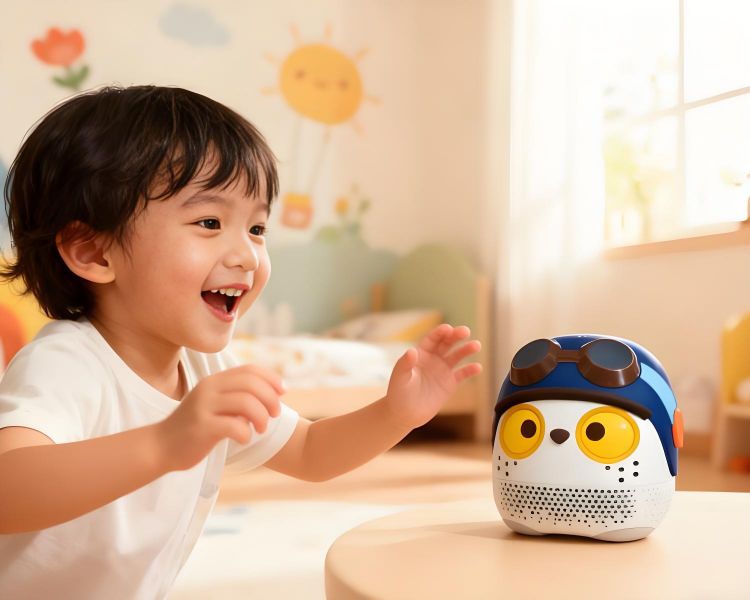
AI education and companion robots: Projects like Leju AI robot showcase how approachable forms, friendly CMF, and robust mechanisms support interactive AI behaviors for families and classrooms.
AI EEG and medical devices: In healthcare, LKK has supported startups with AI-enabled diagnostic equipment, combining clinical-grade accuracy with user-centric design.
Each case underlines the same principle: AI-driven interaction must be anchored in a physical product that users trust, understand, and enjoy using.
AI interactive products are often hardware-intensive: multiple cameras, sensors, mic arrays, high-performance chips, and sophisticated housings. If manufacturability is not considered early, projects can stall when scaling beyond prototype batches.
LKKER SCM’s contract manufacturing and manufacturing engineering capabilities ensure that AI interactive industrial design remains grounded in reality:
DFM for complex enclosures and multi-part assemblies
Thermal and EMC considerations for AI processors and radios
Supplier matching for optics, displays, and precision mechanisms
Production verification and quality systems for long-term reliability
By keeping design and manufacturing under one roof, the team reduces risk and protects margins as volumes grow.
For startups and innovation teams, AI interactive industrial design is not just a trend; it is a strategic differentiator. Products that understand users, adapt over time, and communicate clearly will outperform static devices in retention, engagement, and perceived value.
LKK Design’s integrated approach—from AI concept to industrial design, engineering, and mass production—gives you a single partner to build these next-generation experiences. If you are planning a new AI-powered device, what is the primary interaction you want to enable—vision, voice, gestures, or something else?


We use cookies to ensure that we give you the best experience on our website. By clicking "Accept All", you consent to our use of cookies. Learn more.
Please fill out the form and we'll get back to you shortly.

Your submission has been received !
Thank you for your submission.
We will get back to you within 24 hours and appreciate your patience.
Enter your details to receive the toolkit for free.