

 Home /
 Transit Packaging Design Services | Protective Packaging Solutions


Transit Packaging Design Services for Safer, Smarter Product Shipping
An item might be excellently designed and still be spoiled on its way because its wrappings are not capable of withstanding the trip. Trucks shake, pallets move, boxes pile, packages fall, and temperature and humidity may vary during the process. These conditions are considered by good transit packaging design services prior to the product entering the supply chain.
- Transit packaging is not just a box or protective insert. It is a product-based engineered system that deals with the environment, shipping route, materials, and the manufacturing process. The correct solution can minimize transit damages, manage the weight of the packaging, enhance warehouse operations, and make the customer experience more uniform.
- In the case of LKK, packaging also relates product protection to design and brand experience. Its packaging services include structural packaging, material choice, prototyping, testing, sustainability, and visual branding, which develops a more comprehensive approach to packaging development.
What is Transit Packaging Design?
Transit packaging design aims to secure products during their transit between the manufacturing plants and warehouses, distributors, retailers, or customers. The design should consider the physical forces that may act on a package during transportation. Such forces usually involve:
• Vibration throughout road transportation.
• Compression from stacking
• Movement of the products within the package.
• Shock during loading and unloading
• Change in temperature and humidity.
• Pallet movement and restraint
• Multiple manipulation during distribution.
This is the reason why transportation packaging design begins with the knowledge of the product and its distribution environment. A consumer product of low weight might require a totally different package than a heavy machine part or a fine electronic part.
Protecting Against Real Transport Conditions
Good transit packaging engineering transforms transportation risks into quantifiable design specifications. Engineers take into account the weight of the product, its geometry, fragility, center of gravity, surface sensitivity, and anticipated handling conditions.
An illustrative case is a delicate electronic device, which might need cushions that restrict acceleration in the event of impact. A heavy industrial component might require structural supports that help to spread compression loads without imposing too much force on the product. Structural supports may be used in conjunction with cushioning materials to form a controlled protective environment in protective packaging engineering.
Important considerations include:
• Mass and size of products.
• Fragility and allowable shock levels
• Cushion stiffness and thickness
• Package drop height
• Vibration exposure
• Compression loads
• Stacking configuration
• Environmental conditions
• Pallet and container set-up.
This method produces customized transit packaging as opposed to using generic cartons and fillers.
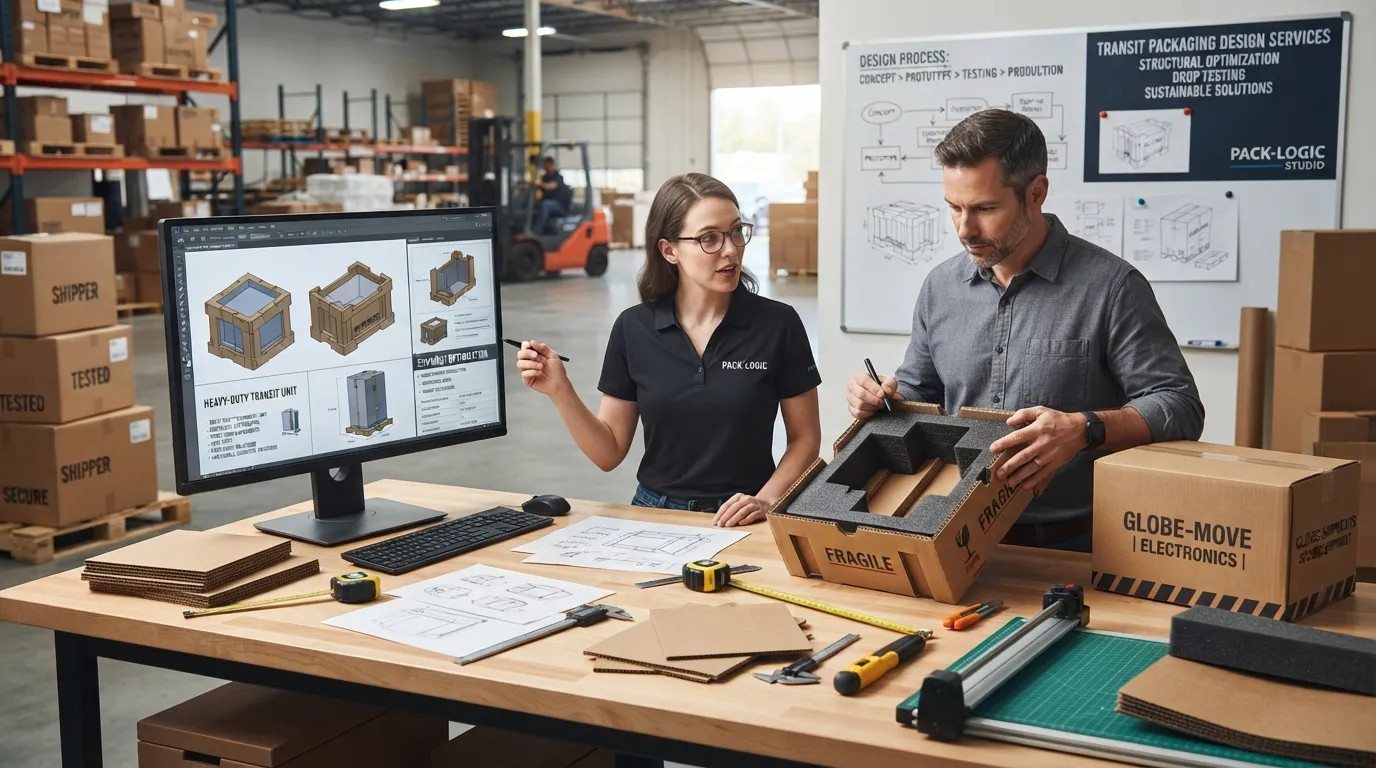
Transit Packaging Testing Evidence Design
The fact that a product fits into a package does not mean that it is production-ready. Transit packaging testing assists in deciding whether the entire system is able to endure realistic distribution conditions. Typical types of packaging performance testing are:
• Drop testing packaging
• Vibration testing packaging
• Compression testing packaging
• Packaging shock testing
• Packaging environmental testing
• Transportation simulation testing
• Shipping simulation testing
• Transit damage testing
Impact resistance with various orientations and heights can be tested with drop tests. Vibration testing is capable of simulating repeated motion that may be experienced during road, rail, or other transportation. A compression testing package is used to test stacking performance.
ISTA packaging testing can also be taken into consideration in instances where a package has to exhibit performance relative to established distribution test procedures. The right testing methodology will be based on the product, distribution channel, type of package, and the project requirements. Testing provides valuable evidence for package validation and may reveal flaws before massive shipments.
Selecting the Right Materials for the Journey
The choice of material directly influences the performance of the packages. The choice of packaging material must be based on strength, cushioning behavior, weight, cost, recyclability, availability, and manufacturing needs. Common materials include:
Corrugated Packaging
Corrugated shipping boxes are also still in demand due to their good weight, cost, printability, and recyclability balance. Designs can be based on various flute profiles or board constructions depending on the load requirements.
Double Wall Corrugated Packaging
This construction offers extra rigidity and strength to heavier products or challenging distribution conditions. Foams may be formed into designed inserts which cushion and position delicate products.
Molded Pulp Packaging
Fiber-based materials can be used to form shaped protective structures through molded pulp packaging. It may be applicable in situations where companies desire to have alternatives to traditional plastic cushioning.
Molded Fiber Packaging
Another fiber-based solution to protective structures and product presentation is molded fiber packaging.
Plastic Packaging Engineering
Reusable structures, rigid plastic trays and formed components can be used to offer repeatable protection in cases where durability and dimensional consistency are critical.
Reusable Packaging Materials
Reusable systems can be applicable in closed-loop supply chains where the packaging is continually transferred between suppliers and manufacturing sites. The actual performance requirements should always be the basis of material decisions as opposed to trends.
Production Should Be Included in Design
A package may do well during the testing but cause issues on the production floor when it is hard to assemble. The manufacturability should be taken into account in packaging engineering services, however. The packaging teams can consider folding sequences, insert placement, adhesive needs, assembly time, tooling, tolerances, material availability, and volumes of production.
Packaging process engineering and packaging engineering support are where they come in handy. The package must be practical for the people and equipment that will utilize it. Development of an effective packaging system can assist businesses in improving:
• Packaging assembly
• Production workflow
• Packaging consistency
• Material usage
• Packing speed
• Quality control
• Production planning
This relationship between design and manufacturing is especially significant in the case of industrial transit packaging, where the products can be heavy, costly, and very sensitive.
Conclusion
Powerful packaging is not an accident. It is based on knowledge of the product, quantification of transportation risks, choice of appropriate materials, testing of the design, and verification of the final package with the real world. Prepared to make your packaging safer, more efficient, and transit packaging design services? Connect with LKK to discuss viable packaging engineering and design solutions that are based on your product and its path.
Contact Us



- 20+ Design Industries Serviced
- 200+ Product Categories
- 1,000+ Industry Leaders Served
- 10,000+ Products Successfully Launched

Founder and Chairman of LKK Design Group
Ready to get started? Connect with us today!
 Talk to Our Team


