

 Home /
 Injection Mold Lead Time Explained: Complete Manufacturing Guide


Injection Mold Lead Time Explained: A Practical Guide
- When a plastic product is at the stage of manufacturing, the first question that may arise is: How long will the mold take? The solution is not often one number. The injection mold lead time is based on the complexity of the part, the design of the mold, the material, the tooling, machining, the number of cavities, the surface finish, and the number of trials required before the production is approved.
- A simple mold of a simple component can pass through the process comparatively fast. A multi-cavity tool with sliders, lifters, tight tolerances, and a high cosmetic demand may take significantly more engineering and validation. Knowing the injection mold schedule enables product teams to plan budgets, prototypes, launch dates, and production schedules with fewer surprises.
What Does Injection Mold Lead Time Include?
The time taken to transition an approved product design to a completed, tested, and production-ready mold is known as injection molding lead time. It usually encompasses a number of related activities:
• Mold design
• Tooling approval
• Material selection
• Mold machining
• Component manufacturing
• Mold assembly
• Mold finishing and polishing
• Initial mold trials
• Dimensional inspection
• Tooling corrections
• Final validation
Thus, the time of injection mold manufacturing cannot be equated with machining time. The entire process of the mould development involves engineering, production, testing, and approval.
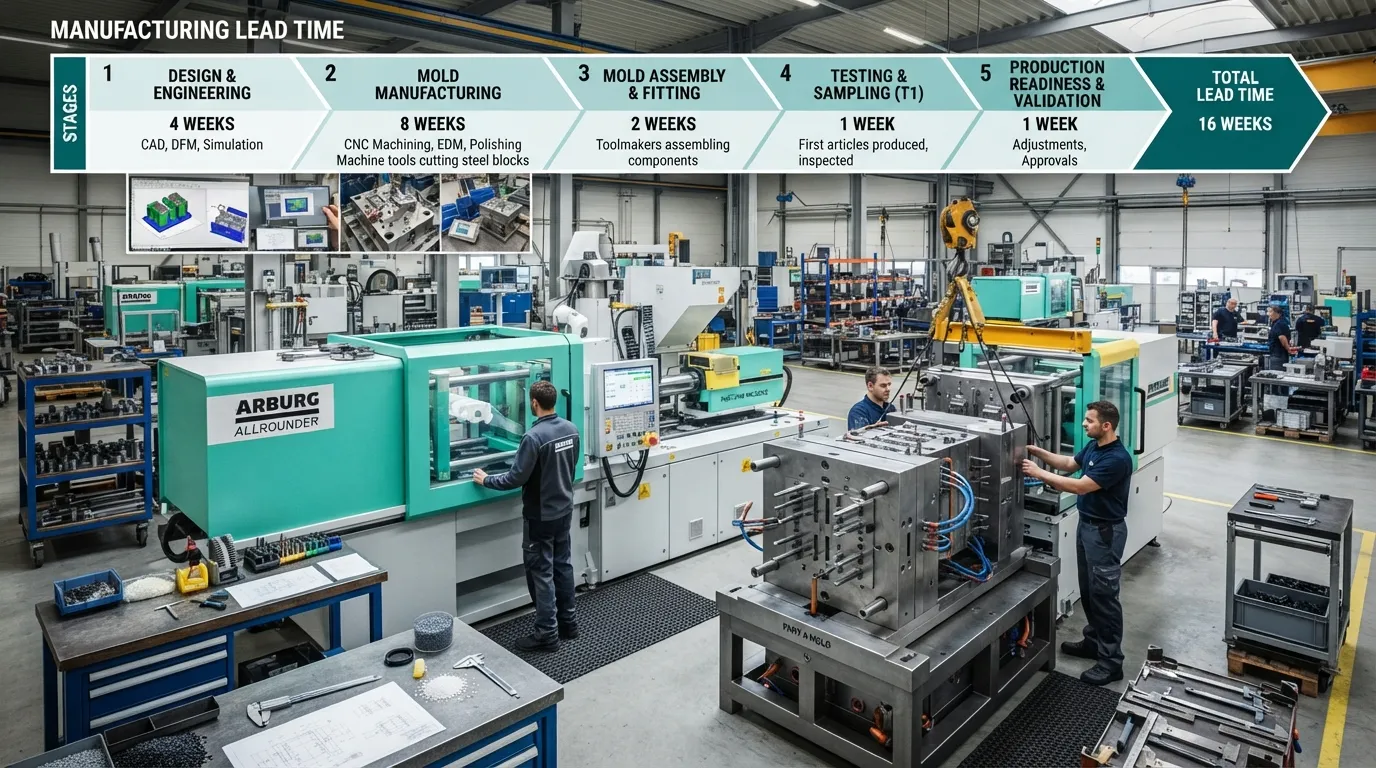
Stage 1: DFM Review and Product Design
The plastic part is the starting point of the Injection mold lead time explained. Prior to the design of injection tooling, engineers must be aware of the geometry of the part, the material, the functional requirements, tolerances, and the anticipated volume of production. This is where DFM injection molding comes in. A design review of manufacturing looks at the efficiency and consistency of molding the part. Engineers may review:
• Wall thickness
• Draft angles
• Ribs and bosses
• Undercuts
• Parting line
• Gate location
• Ejection
• Cooling
• Material shrinkage
• Dimensional tolerances
The correct DFM review is able to detect issues prior to tooling. Should design modifications be necessary, it is normally much easier to make them at this stage than to make them on an already made mold. That is why the DFM approval must be regarded as a step in the injection tooling schedule, but not as an optional engineering procedure.
Stage 2: Injection Mold Design
Once the part design is accepted, the tooling team comes up with the injection mold design. The process of mold design converts the geometry of the part into a tooling structure. This entails the core, cavity, runners, gates, cooling channels, ejector system, mold base, and others.
The design team also takes into consideration how the mold will open and how the completed part will be removed. Complex components can have undercuts released with sliders or lifters. Gates and parting lines can be sensitive on cosmetic parts to reduce visible marks. An elaborate review of the mold design at this phase can avoid manufacturing issues in the future.
Stage 3: Tool Material Choice
The performance, life, cost, and lead time of tools are directly affected by mold material. Aluminum, soft steel, pre-hardened steels, and hardened tool steels are common.
For example:
- Prototypes and low-volume applications can be appropriate with aluminum molds.
- Soft steel tooling may offer a viable trade-off between cost and life.
- Hardened steel can be chosen in case of intensive, high-volume production.
The right decision is based on the number of shots to be expected, resin, part geometry, tolerances, surface requirements, and volume of production. The choice of the right material at the initial stage is useful in avoiding modifications that may increase the custom injection mold lead time.
Stage 4: CNC and EDM Machining
After the design of the mold is accepted, it starts to be manufactured. Many of the major components of the moulds are made by CNC mold machining. Complex cavity and core surfaces with tight dimensional control can be made by high-speed machining. Nevertheless, other characteristics are hard or inefficient to manufacture with traditional CNC machining alone.
Here, EDM mold machining comes in handy. Electrical discharge machining is able to produce complex cavities, sharp edges, deep lines, and geometries that are hard to reach using conventional cutting tools. The total mold manufacturing process can thus be a combination of:
• CNC machining
• EDM machining
• Drilling
• Grinding
• Wire EDM
• Heat treatment
• Surface finishing
The real-time is largely dependent on the complexity of molds and the number of operations necessary.
Stage 5: Mold Finishing and Polishing
Injection mold production time can also depend on the necessary surface finish. A technical industrial part might require a fairly simple machined surface. A consumer product might need to be polished, textured, or have a very controlled cosmetic finish. Mold finishing may involve:
• Grinding
• Polishing
• Texturing
• Surface treatment
• Manual finishing
Optical or cosmetic surfaces that are highly polished may demand a lot of extra work. This is why surface requirements must be determined prior to the manufacturing process.
What Can Add to Injection Mold Lead Time?
The lead time of the manufacturing of molds can be prolonged by a number of factors.
Complex Geometry
The machining and tooling needs may be augmented by undercuts, deep cuts, thin walls, and complex details.
Multiple Cavities
A multi-cavity mold should be consistent throughout all the cavities. This adds design, machining, balancing, and validation.
Tight Tolerances
Components that demand strict dimensional control might be in need of further machining and inspection.
Cosmetic Requirements
Finishing time can be increased by high-gloss surfaces, textures, visible gates, and challenging appearance standards.
Design Changes
Any changes made after tooling has begun can cause serious delays since parts that are already finished or half-finished might have to be changed.
Special Tooling Systems
Hot runners, sliders, lifters, interchangeable inserts, and other mechanisms can add to the engineering and manufacturing time.
The Way LKK Assists the Tooling Journey
- LKK does not consider tooling as a separate activity but as a part of the contract manufacturing process. Its published manufacturing process comprises DFM, mold design and review, tooling fabrication, injection molding, validation, and production support.
- Such an integrated workflow can assist in decreasing the communication distances between product engineering, tooling, molding, quality, and production teams.
- LKK also offers more extensive manufacturing services such as CNC machining, injection molding, die casting, sheet metal fabrication, surface treatment, assembly, and testing that can be applicable to products that have plastic components with other manufactured products.
Conclusion
The secret of Injection Mold Lead Time Explained is to consider the whole process, and not only the machining part. The final timeline is added to by product geometry, DFM, mold design, material selection, machining, assembly, finishing, trials, corrections, and validation. Ready to design your tooling project with fewer surprises? Collaborate with LKK to integrate DFM, mold engineering, tooling, validation, and manufacturing into a more integrated route to production.
Contact Us



- 20+ Design Industries Serviced
- 200+ Product Categories
- 1,000+ Industry Leaders Served
- 10,000+ Products Successfully Launched

Founder and Chairman of LKK Design Group
Ready to get started? Connect with us today!
 Talk to Our Team