
 Home /
 Industrial Design Process for Hardware Startups | Complete Guide


Industrial Design Process for Hardware Startups: From Idea to Physical Product
An Industrial Design Process for Hardware Startups begins with an idea, but an idea alone cannot become a successful physical product. It requires form, functionality, utility, technical reasoning, and a production direction.
- This is where the industrial design process comes in. In the case of startups, industrial design bridges the gap between what people desire and what is feasible to design, engineer, prototype, and manufacture.
- For a hardware startup, good industrial design is not merely about making a device look good. It takes into account the ergonomics, materials, form, functionality, interaction with the user, manufacturing requirements, and the technical constraints of the product at the outset.
- In the case of a new hardware company, this would help eliminate expensive alterations in the future and establish a far more transparent path between product concept and manufacture.
What is Hardware Startup Industrial Design?
Industrial Design Process for Hardware Startups refers to the procedure of establishing how a tangible product ought to appear, feel, operate, and interrelate with the users. It lies between early product thinking and detailed engineering. Designers experiment with various shapes and characteristics, keeping in mind the product needs, the intended users, the technology, materials, and the manufacturing environment. An average industrial design project can consist of:
- Product discovery and market research.
- User needs analysis
- Product ideation
- Concept generation
- Industrial design sketches
- Concept selection
- 3D product visualization
- Physical prototypes
- Design refinement
- Design validation
- Manufacturing considerations
The idea is to transform an uncertain idea into a product direction that can be worked on by engineers and manufacturers. LKK industrial design services specialize in product development based on user requirements, product functionality, product appearance, product ergonomics, and practical considerations of manufacturing, to help convert ideas into real product designs.
Begin with Product Discovery, Not CAD
Among the simplest errors in the design of hardware startup products is to begin detailed CAD work prematurely. The team must know the users of the product and their reasons before developing a complex model. It is here that product discovery, customer discovery, and market opportunity analysis can be of great guidance. The team can investigate:
- Target customers and their requirements.
- Existing competing products
- Common user frustrations
- Expected price range
- Product positioning
- Important features
- Environmental conditions
- Expected usage frequency
- Potential manufacturing constraints
This study promotes user-centered design and human-centered design. The team can make decisions based on real user requirements rather than designing based on assumptions. It also assists in developing a more robust product design brief, which can be used as a valuable guide during the project.
Converting Research into Product Concepts
After getting a better understanding of the opportunity, the designers can proceed to product ideation and concept development. There must not be just one solution at this stage. Exploration of the design will tend to generate multiple possible directions before the team settles on one. An example of a wearable hardware product to investigate:
- Form factors
- Button arrangements
- Display positions
- Strap systems
- Charging methods
- Materials
- Enclosure shapes
- User interaction methods
Concept sketching, product sketching, and initial 2D product drawings are usually aids to this stage. This is not to produce beautiful art in itself. Sketches enable a team to make comparisons of ideas in a short period of time before committing a lot of money to engineering.
Sketches to 3D Product Visualization
Once the concept is selected, the direction is further detailed. The 3D product visualization and CAD models are developed by designers to experiment with dimensions, proportions, surfaces, interfaces, and component placement. In the case of a hardware product, this step can look at:
- Overall dimensions
- Wall thickness
- Component clearance
- PCB location
- Battery placement
- Connector positions
- Button travel
- Display opening
- Assembly access
- Screw locations
- Material transitions
- Surface finishes
Here the industrial design starts to come into closer contact with engineering. The external appearance should be able to fit the interior product. It is of little use to have a beautiful enclosure when the PCB, battery, thermal components, antenna, connectors, or other hardware do not fit into the enclosure.
Why Hardware Engineering Needs to Get in Early
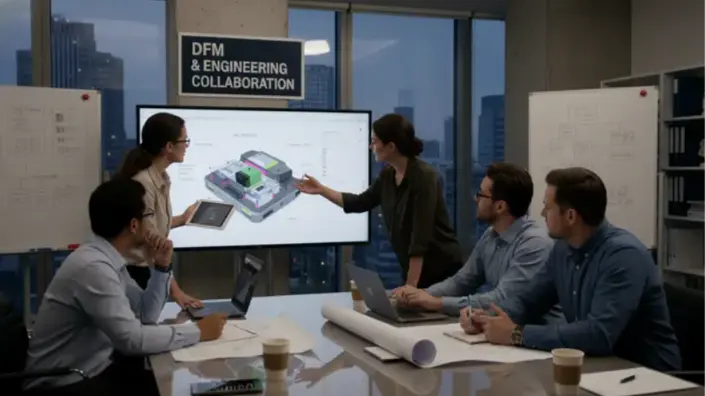
- The process of industrial design development cannot work in isolation from engineering. In the case of electronics products, industrial designers might have to collaborate with electrical engineers, mechanical engineers, and other technical experts. This is particularly important when the product includes PCB assemblies, batteries, sensors, displays, motors, wireless modules, or embedded electronics.
- This combined method helps in the improved design and development of products since both physical appearance and technical needs are taken into account. In the case of startups, startup product engineering and design can also work together at an early stage to reveal issues before they become costly.
Prototyping Brings the Design to Life
Prototyping of hardware products provides the team with something tangible to touch, test, measure, and criticize. Various prototype techniques can be applied based on the level of the project. A startup may check its forms with 3D printing, make prototypes stronger with CNC machining, or use any other technique when the design needs more realistic materials and finishes. A prototype may demonstrate problems with:
- Grip and ergonomics
- Button placement
- Screen visibility
- Product size
- Assembly access
- Cable routing
- Component clearance
- Structural strength
- Material feel
- User interaction
This makes design iteration much more productive. The team can create a design and learn through the physical outcome rather than discussing whether it will work or not.
Relating Industrial Design to Hardware Development
The Industrial Design Process for Hardware Startups ultimately converges with the wider hardware product development process. At this point, industrial design collaborates with:
- Mechanical engineering
- Electrical engineering
- Electronics engineering
- PCB design
- Embedded systems
- Firmware development
- Component selection
- Prototype development
- Manufacturing engineering
This connection is especially significant when it comes to the development of new hardware products since alterations in one domain may impact various ones. As an example, a PCB modification might be necessary to change the size of the enclosure. The internal mechanism can be influenced by moving a button. The material can be changed to change the weight, durability, tooling, or manufacturing cost. This is why the product development of hardware startups is better supported by an integrated workflow, as opposed to autonomous design choices.
Conclusion
Amazing hardware is not accidental. It expands by research, considered ideas, physical experimentation, engineering partnership, and trial and error. The best industrial design procedure provides a startup with more than an appealing product. It forms a practical basis for engineering, prototyping, manufacturing, and long-term product development.
When you are creating a new physical product, LKK can assist in transforming initial concepts into thoughtful industrial designs that are prepared to undergo more engineering and development. Bring your next hardware idea to LKK and transform the idea into a product worth developing.
Contact Us



- 20+ Design Industries Serviced
- 200+ Product Categories
- 1,000+ Industry Leaders Served
- 10,000+ Products Successfully Launched

Founder and Chairman of LKK Design Group
Ready to get started? Connect with us today!
 Talk to Our Team