
 Home /
 Supply Chain Resilience: Lessons from 20 Years of Manufacturing in China



Introduction
In 2020, when a global pandemic brought manufacturing to its knees, companies with resilient supply chains survived. Those relying on single-source suppliers or lean inventory strategies didn't. Three years later, geopolitical tensions disrupted semiconductor supplies. In 2025, we watched as climate events and port strikes created new waves of chaos.
The pattern is clear: disruption isn't an anomaly—it's the new normal.
For product managers, procurement directors, and hardware startups, building supply chain resilience isn't optional anymore. It's existential. Yet resilience isn't about hoarding inventory or paying premium prices for redundancy. It's about smart design choices, strategic supplier relationships, and operational practices that absorb shocks without breaking.
At LKK Design, we've navigated supply chain crises alongside our clients for over two decades. We've learned what separates resilient supply chains from fragile ones. In this article, we'll share those lessons—practical strategies you can implement regardless of company size.
Why Traditional Supply Chain Thinking Fails
The Lean Supply Chain Paradox
The lean manufacturing philosophy—developed largely by Toyota in the post-war era—revolutionized how companies think about inventory and efficiency. Zero inventory, just-in-time delivery, and single-source supplier relationships dramatically reduced costs and improved quality consistency.
But lean comes with a hidden assumption: that supply will flow steadily and predictably.
When it doesn't, lean supply chains collapse catastrophically. A single supplier disruption cascades through the entire system. No safety stock means no buffer. The efficiency that looked so elegant in spreadsheets becomes a liability when reality intervenes.
The math is unforgiving:
| Supply Chain Model | Cost Efficiency | Resilience Rating | Recovery Time |
|---|---|---|---|
| Pure Lean | ★★★★★ | ★☆☆☆☆ | Weeks to Months |
| Lean + Buffer | ★★★★☆ | ★★★☆☆ | Days to Weeks |
| Resilient Multi-Tier | ★★★☆☆ | ★★★★★ | Hours to Days |
The Globalization Trap
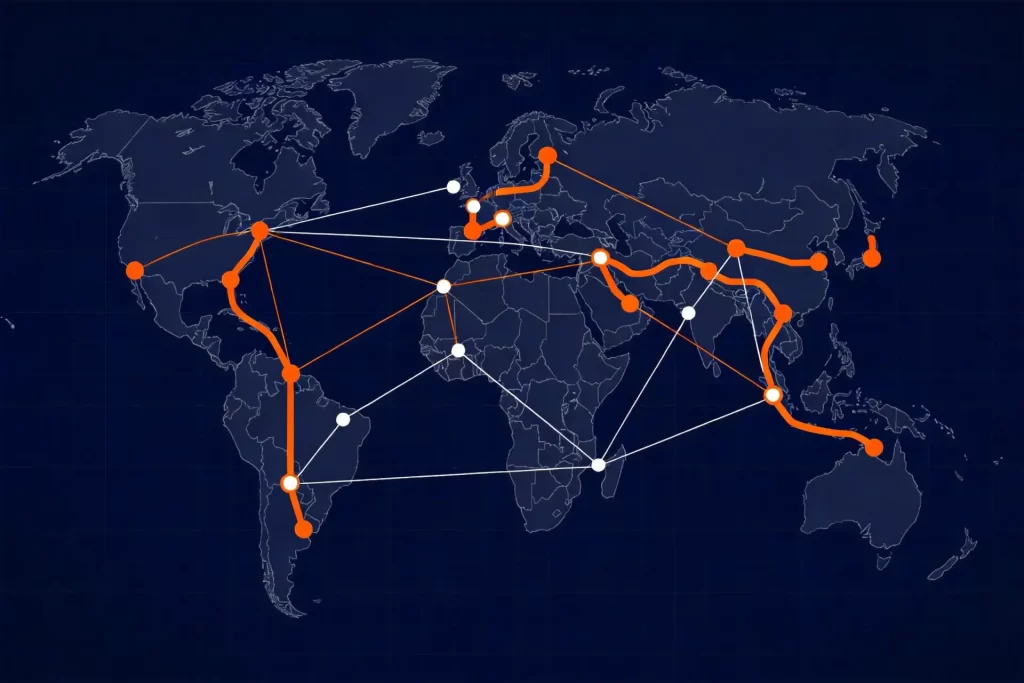
Globalized supply chains pursue lowest-cost production by distributing manufacturing across multiple geographies. While this reduces per-unit costs, it creates new vulnerabilities:
- Longer lead times increase exposure to disruption
- Geographic concentration in low-cost regions creates chokepoints
- Cultural and language barriers slow problem resolution
- Transportation dependencies multiply failure points
The 2021 Suez Canal blockage—which held up $9.6 billion in trade for six days—illustrated how a single point of failure can ripple across global supply networks. For companies sourcing components from multiple continents, a week of delays translated into months of inventory shortages.
The Four Pillars of Supply Chain Resilience
After working with 300+ enterprise clients and navigating multiple supply chain crises, we've identified four foundational pillars that distinguish resilient supply chains from fragile ones.
Pillar 1: Supplier Ecosystem Design
Resilient supply chains aren't built on single relationships—they're built on strategic supplier ecosystems.
Multi-Source Strategically, Not Universally
Not every component needs multiple suppliers. Sourcing the same USB cable from three factories adds cost and complexity without proportional resilience benefit. Instead, apply multi-sourcing selectively:
High-Risk Components (Always Multi-Source):
- Critical functional components with long lead times
- Components from geopolitically sensitive regions
- Specialized parts with limited supplier base
- Components with history of supply volatility
Low-Risk Components (Optimize for Cost):
- Commoditized parts with many qualified suppliers
- Non-critical components where substitution is easy
- Standard parts with short lead times
Tiered Supplier Relationships
Create depth in your supplier ecosystem:
| Tier | Role | Relationship Model | Investment Level |
|---|---|---|---|
| Primary | Main production partner | Strategic alliance | High - joint development, capacity reservations |
| Secondary | Capacity backup, risk mitigation | Preferred status | Medium - regular qualification, volume commitments |
| Qualified Backup | Emergency coverage | Transactional | Low - periodic qualification, spot capacity |
The 150% Rule: Your primary supplier should have 150% of your expected volume capacity. This ensures they remain a priority even during high-demand periods, and provides headroom for you to surge production when needed.
Pillar 2: Visibility Across the Supply Chain
You can't manage what you can't see.
Traditional supply chain visibility stops at tier-1 suppliers (your direct vendors). But disruptions often originate deeper in the supply chain—at your supplier's supplier, or beyond. The 2011 Thailand floods demonstrated this: automotive manufacturers worldwide were blindsided because their visibility stopped too shallow.
Building Multi-Tier Visibility:
Tier 1 Visibility (Essential):
- Real-time inventory levels at supplier warehouses
- Production schedules and capacity utilization
- Quality metrics and on-time delivery performance
- Financial health indicators (where possible)
Tier 2 Visibility (Recommended):
- Key sub-component inventory at critical tier-1 suppliers
- Capacity utilization of critical tier-1 production lines
- Material availability for long-lead components
Tier 3 Visibility (Strategic):
- Raw material sourcing patterns
- Geographic concentration of critical inputs
- Second-tier supplier financial health
At LKK Design, we maintain direct relationships with 3,000+ verified suppliers across all tiers, giving our clients visibility that would take years to build independently.
Pillar 3: Flexible Response Capability
Resilience isn't about preventing disruption—it's about responding faster when disruption occurs.
Design for Manufacturability (DFM) as Risk Mitigation
One of the most powerful resilience strategies is designing products that can be manufactured multiple ways. DFM isn't just about cost optimization—it's about creating options.
Example: A product originally designed with a specific brand of microcontroller can be redesigned to accept multiple pin-compatible alternatives. When component shortages hit that specific brand, you have alternatives ready to deploy.
DFM strategies that enhance resilience:
- Standardized interfaces allow component substitution
- Modular architecture isolates disruption to affected modules
- Multiple assembly options provide geographic flexibility
- Test-point accessibility enables faster re-qualification
Buffer Strategies That Actually Work
Traditional safety stock is expensive. But modern buffer strategies can provide resilience without breaking the bank:
| Buffer Type | When to Use | Cost Impact | Resilience Value |
|---|---|---|---|
| Physical Inventory | Long lead time, critical components | High (carrying costs) | High |
| Virtual Buffer | Components with substitutes | Low (no carrying cost) | Medium |
| Capacity Reservation | High-demand periods | Medium (opportunity cost) | High |
| Dual-Track Production | Extreme volatility | High (complexity) | Very High |
Strategic Inventory Placement: Not all inventory belongs in your warehouse. Strategically positioned inventory at tier-1 suppliers or regional distribution centers can provide resilience with lower total cost.
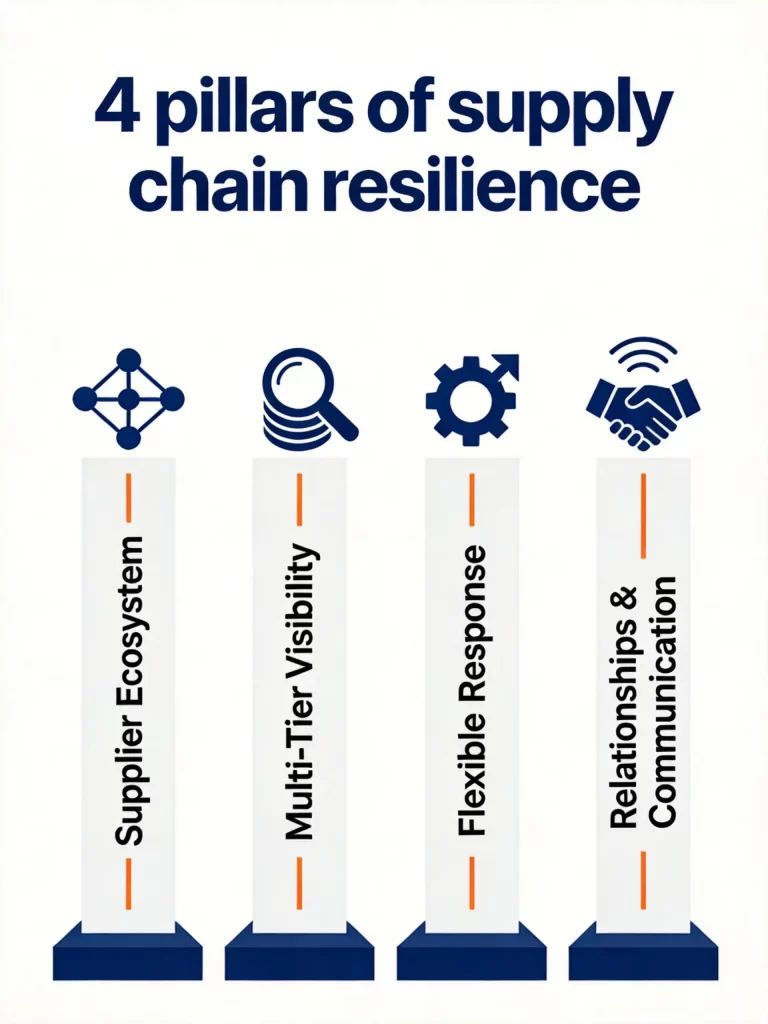
Pillar 4: Relationships and Communication
During crisis, relationships matter as much as contracts.
Supplier Communication Cadence
Resilient companies maintain constant dialogue with suppliers—not just during problems, but always. Regular communication builds:
- Early warning systems: Suppliers who trust you will alert you to problems before they become crises
- Priority treatment: When everyone is competing for limited supply, relationship matters
- Collaborative problem-solving: Jointly developed solutions are faster and more effective
Communication Framework:
| Frequency | Audience | Topics |
|---|---|---|
| Weekly | Key suppliers | Demand forecasts, capacity outlook |
| Monthly | Strategic suppliers | Business review, development roadmap |
| Quarterly | All qualified suppliers | Market outlook, strategic direction |
| Ad-hoc | All suppliers | Urgent issues, disruption alerts |
Contractual Flexibility
Contracts should include provisions for disruption scenarios:
- Force majeure clauses that protect both parties fairly
- Volume flexibility bands that accommodate demand variance
- Price adjustment mechanisms that reflect market realities
- Priority allocation terms that guarantee access during shortages
In 2021, the global semiconductor shortage forced many electronics manufacturers to halt production. Here's how we helped a client not just survive, but gain competitive advantage.
The Challenge:
A consumer electronics startup had designed their flagship product around a specific microcontroller that became unavailable for 9+ months. Their entire roadmap was at risk.
Our Approach:
- Rapid DFM: We redesigned the product architecture to accept three pin-compatible microcontroller alternatives within 6 weeks
- Supplier Ecosystem Mapping: We identified 12 qualified alternative suppliers across Taiwan, South Korea, and Japan
- Parallel Qualification: We simultaneously qualified all alternatives, giving our client options
- Strategic Inventory: We secured 6-month inventory of the primary choice while maintaining qualified alternatives
The Outcome:
While competitors waited 6-9 months for unavailable components, our client launched on time using an alternative chip—with identical performance and lower per-unit cost. Their time-to-market advantage translated into 40% market share capture in their category.
Key Lesson: Resilience isn't about predicting which disruption will hit. It's about building the capability to respond quickly regardless of what happens.
Building Your Resilience Roadmap
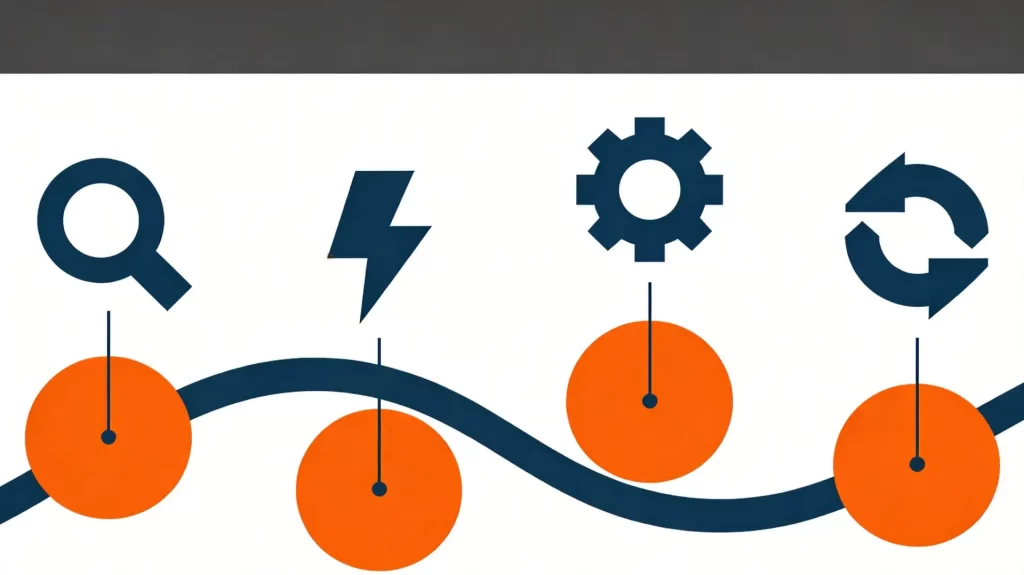
Resilience isn't built overnight. It's a capability that develops over time. Here's a practical roadmap:
Phase 1: Assessment (Weeks 1-4)
Actions:
- Map your current supply chain (tier-1 minimum)
- Identify single-source components and high-risk suppliers
- Assess current inventory buffers and lead time exposure
- Review contractual protections and flexibility provisions
Deliverables:
- Supply chain risk matrix
- Critical component list
- Gap analysis vs. resilience best practices
Phase 2: Quick Wins (Weeks 5-12)
Actions:
- Multi-source the highest-risk components
- Establish communication cadence with strategic suppliers
- Add flexibility provisions to new contracts
- Document substitution options for critical components
Deliverables:
- Qualified backup supplier list
- Supplier communication protocols
- Updated component specifications with alternatives
Phase 3: Systematic Build (Months 4-12)
Actions:
- Build multi-tier visibility systems
- Implement strategic inventory optimization
- Develop response playbooks for common disruption scenarios
- Train procurement and engineering teams on resilience principles
Deliverables:
- Supply chain visibility dashboard
- Inventory optimization model
- Disruption response playbooks
- Resilience capability assessment
Phase 4: Continuous Improvement (Ongoing)
Actions:
- Quarterly resilience audits
- Annual supply chain strategy reviews
- Continuous supplier ecosystem development
- Industry benchmarking and best practice adoption
How LKK Design Strengthens Your Supply Chain
With 3,000+ verified suppliers, 20+ years of relationship building, and integrated design-to-production services, LKK Design offers unique supply chain resilience capabilities:
Supplier Ecosystem Access:
- Pre-qualified supplier network across all major manufacturing regions
- Established relationships with capacity commitments
- Multi-tier visibility from raw materials to finished goods
- Geographic diversification options for production
Integrated Resilience Services:
- Supply chain risk assessment and mapping
- DFM services that design for component flexibility
- Strategic inventory planning and management
- Disruption response and recovery support
Proven Track Record:
- Navigated 2021 semiconductor shortage for 50+ clients
- Zero production stoppages due to supply chain issues in 2023-2025
- Average 30% faster recovery time vs. industry benchmarks
Conclusion
Supply chain resilience isn't about eliminating risk—that's impossible. It's about building the capability to absorb shocks and recover faster than competitors.
The companies that thrive in volatile markets aren't the ones that predicted every disruption. They're the ones that built adaptable supply chains—strategic supplier ecosystems, multi-tier visibility, flexible response capabilities, and strong relationships.
The time to build resilience is before crisis hits. Start with assessment. Identify your highest risks. Multi-source strategically. Design for flexibility. Communicate constantly.
And remember: in supply chain, as in engineering, the most elegant solution isn't always the leanest. Sometimes, a little extra investment in resilience pays dividends that spreadsheets can't calculate.
Ready to strengthen your supply chain? Contact LKK Design to discuss how our integrated services can build resilience into your product development and manufacturing operations.
Contact Us



- 20+ Design Industries Serviced
- 200+ Product Categories
- 1,000+ Industry Leaders Served
- 10,000+ Products Successfully Launched

Founder and Chairman of LKK Design Group
Ready to get started? Connect with us today!
 Talk to Our Team