
 Home /
 Supplier Audit Checklist: 15 Critical Points for Qualifying Your Manufacturing Partner



Introduction: Why Your Supplier Selection Process Determines Your Product's Fate
You've seen the horror stories. A startup launches on Kickstarter with a revolutionary smart home device, raises $2 million, and then watches in horror as their Chinese manufacturer delivers 40% defective units. The community erupts. The refund requests flood in. The company collapses before it ever ships a second batch.
This isn't a rare edge case. In our 20+ years of helping hardware companies navigate manufacturing in China, we've seen this pattern repeat itself dozens of times. And the common thread? Most of these failures could have been prevented with a proper supplier qualification process.
The contract manufacturer you choose becomes the backbone of your entire supply chain. They're not just fabricating parts—they're shaping your quality reputation, controlling your cost structure, and either enabling your growth or destroying it. The selection decision deserves more than a factory tour and a handshake.
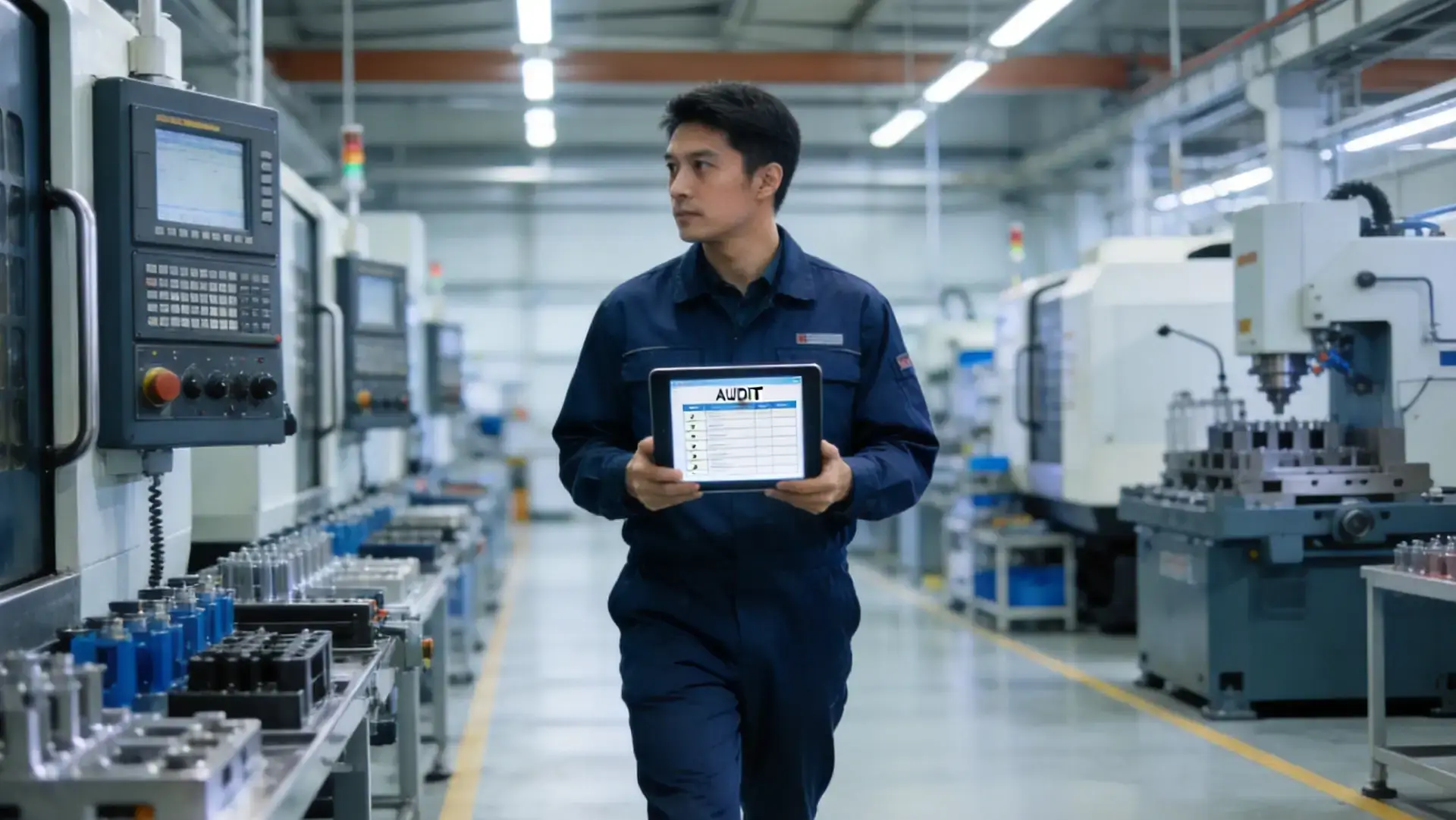
This guide provides a structured supplier audit checklist with 15 critical qualification points that experienced procurement teams use to evaluate manufacturing partners. Whether you're sourcing your first prototype run or qualifying a supplier for mass production, these criteria will help you make decisions based on evidence rather than optimism.
Before the Audit: Define Your Requirements First
Before you evaluate any supplier, you need absolute clarity on what you're asking them to do. Vague requirements produce vague qualifications.
Document these fundamentals:
• Production volume: Are you planning for 500 units/month or 50,000 units/month? Different factories excel at different scales.
• Technical requirements: What materials, tolerances, and certifications does your product demand?
• Quality standards: What's your acceptable defect rate? (Industry standard is typically <1% for consumer electronics)
• Timeline: When do you need samples? First production run? Full-scale delivery?
• Location preferences: Does proximity to your team matter? Some companies need suppliers near specific ports or logistics hubs.
Without these parameters defined, you'll waste time evaluating suppliers who aren't even in the right category for your needs.
The 15-Point Supplier Audit Checklist
Phase 1: Basic Capability Verification (Points 1-4)
These foundational checks determine whether a supplier can even attempt to do what you need.
1. Business License and Legal Registration
Verify the supplier is a legally registered entity in China. Request their business license and cross-reference the registered capital, company name, and legal representative with China's State Administration for Industry and Commerce (SAIC) database. Be wary of trading companies that resell from other factories—this adds cost and removes transparency.
What to look for: Registered capital matching the scale of your project. Trading companies aren't inherently bad, but you should know who you're actually dealing with.
2. Manufacturing License and Industry Certifications
Does your product require specific manufacturing capabilities? If you're making medical devices, you need ISO 13485. For electronics, ISO 9001 is the baseline. Automotive requires IATF 16949. Request copies of all relevant certifications and verify them directly with the issuing certification body—suppliers have been known to display expired or even fake certificates.
3. Production Capacity vs. Your Volume
Ask specifically about their current capacity utilization. A factory running at 90% capacity may not be able to meet your urgent needs. Conversely, a factory at 20% capacity might be struggling with quality issues (why else would they be idle?).
Request their production capacity for your specific process (injection molding, PCB assembly, die casting, etc.) and compare against your projected volumes.
4. Facility Size and Equipment Inventory
Request a video walkthrough or, better yet, conduct an in-person visit. Assess:
• Cleanliness and organization of the production floor
• Age and condition of equipment
• Layout efficiency (is there excessive material handling?)
• Worker-to-machine ratios (indicates automation level and labor costs)
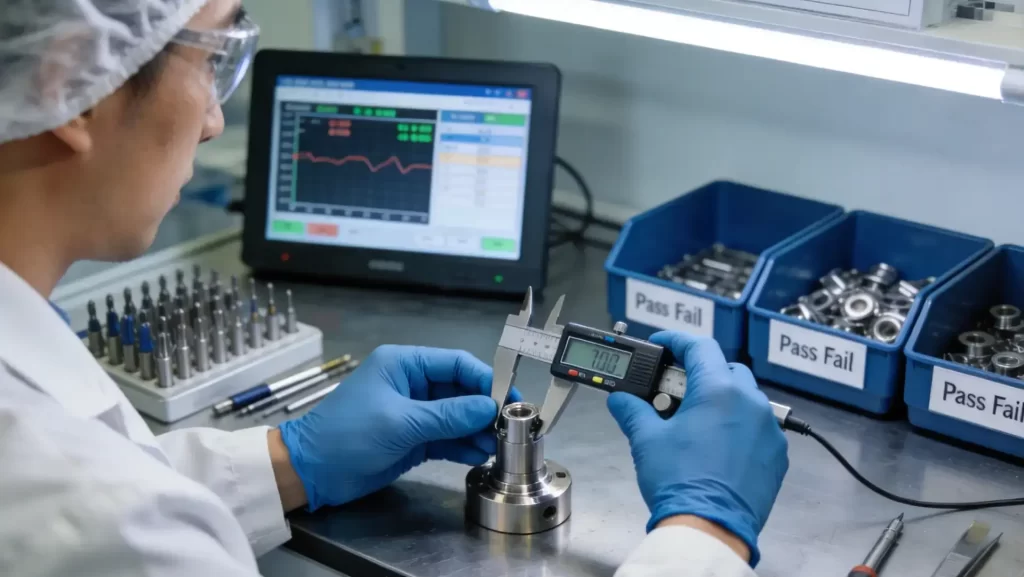
Phase 2: Quality Management System (Points 5-8)
These points assess whether the supplier has systems in place to consistently produce quality products.
5. Incoming Material Inspection Process
Quality starts before production. Ask how they verify incoming raw materials and components. Do they have IQC (Incoming Quality Control) procedures? What's their documented process for handling non-conforming materials?
6. In-Process Quality Controls
Request their IPC (In-Process Control) procedures. At what stages do they check critical dimensions, functional parameters, and visual appearance? For complex products, there should be multiple checkpoints throughout production.
7. Final Inspection and Testing Procedures
What does their FQC (Final Quality Control) look like? For electronics, this should include ICT (In-Circuit Test) and functional testing. For mechanical products, this includes dimensional verification and functional testing under load.
Ask specifically: What's their defect rate history? Can they provide data from recent production runs?
8. Documentation and Traceability Systems
Can they trace any finished unit back to:
• The specific production batch and shift
• The raw material lot numbers used
• The operators who worked on it
• The inspection results at each stage
Full traceability is essential for handling field failures and conducting root cause analysis.
Phase 3: Engineering and Technical Capabilities (Points 9-11)
Production capability means nothing if they can't solve problems or optimize your design for manufacturing.
9. Engineering Team and DFM Experience
Ask about their engineering support. Do they have dedicated DFM (Design for Manufacturing) engineers who can review your designs and suggest cost-saving modifications? Or do they simply build exactly what you send?
The best manufacturing partners act as technical consultants, helping you optimize designs for their specific processes and equipment.
10. Tooling and Fixture Capabilities
For products requiring custom tooling (injection molds, die casting dies, stamping dies), ask:
• Do they manufacture tooling in-house or outsource?
• What's their typical tooling lead time?
• What is the tooling approval process?
• How long do they warranty tooling?
In-house tooling capabilities typically indicate better process control and faster iteration cycles.
11. Prototype and NPI Support
If you're in the development phase, confirm they can support NPI (New Product Introduction). Some factories only accept high-volume production runs and treat prototypes as a nuisance. You need a partner willing to work through initial iterations with you.
Phase 4: Business Stability and Risk Assessment (Points 12-15)
Technical capability is necessary but not sufficient. You need to assess long-term viability and risk.
12. Financial Health Indicators
Request financial statements or work with a credit check service in China. Key indicators:
• Revenue trend over the past 3 years (growing, stable, or declining?)
• Debt levels and payment terms with their own suppliers
• Any pending litigation or financial disputes
A factory that goes bankrupt six months after starting your production run will cost you far more than any audit ever saved.
13. Customer References and Case Studies
Ask for references from companies in similar industries producing similar complexity. Follow up directly. Ask specific questions:
• Did they meet delivery schedules?
• What was their actual defect rate vs. promised rate?
• How did they handle problems when they arose?
• Would you work with them again?
Be skeptical of suppliers who can only provide glowing references from companies that no longer exist.
14. Communication and Language Capabilities
This is often underestimated until you're three time zones away trying to resolve a quality crisis. Assess:
• English proficiency of their account managers and engineers
• Response time expectations and actual responsiveness
• Preferred communication tools and availability
• Documentation language (drawings, reports, specifications)
Poor communication has destroyed more overseas manufacturing relationships than quality issues have.
15. Scalability and Growth Roadmap
Your first order might be 1,000 units. Where will you be in three years—10,000 units? 100,000 units? Does this supplier have the ability to scale with you, or will you be forced to repeat this entire qualification process again?
Ask about their equipment investment plans, facility expansion capabilities, and strategy for handling rapid volume increases.
How to Conduct the Actual Audit
Remote vs. On-Site Audits
For initial screening, a detailed questionnaire combined with video facility tours can eliminate clearly unsuitable candidates. But for serious production partnerships, on-site audits are non-negotiable.
On-site audits let you:
• Verify documentation matches reality
• Observe actual production conditions (not staged demos)
• Meet the team who will be managing your account
• Assess facility culture and management quality
Plan for 1-2 days for a thorough on-site audit. Bring a structured checklist and rate each point objectively.
Third-Party Audit Services
If you don't have team members with manufacturing expertise and the ability to travel to China, consider engaging a third-party inspection company. Companies like QIMA, Bureau Veritas, and SGS offer supplier audit services for a fraction of what a failed partnership would cost.
Red Flags That Should End the Conversation Immediately
Before you spend more time on any potential partner, watch for these deal-breakers:
• Reluctance to provide references or allow facility visits – They may be hiding something.
• Claims of "no minimum order quantity" for highly customized products – Either they're reselling from other factories or quality will be inconsistent.
• Prices significantly below market rates – There's always a reason. Usually, it's corners being cut.
• No quality management system documentation – They may not have any formalized processes.
• Poor communication during the sales phase – If they're unresponsive now, imagine when you're three months into production with a quality crisis.

Building Your Qualification Matrix
Once you've audited multiple suppliers, create a scoring matrix to compare them objectively:
| Category | Weight | Supplier A | Supplier B | Supplier C |
| Quality Systems | 25% | |||
| Technical Capability | 20% | |||
| Production Capacity | 15% | |||
| Financial Stability | 15% | |||
| Communication | 15% | |||
| References | 10% | |||
| Total Score | 100% |
Weight categories based on what's most critical for YOUR specific product. A medical device company should weight quality systems much higher than price. A startup with extreme cash constraints might weight financial stability higher.
Next Steps After Qualification
Selecting a supplier is the beginning, not the end. Protect your investment with:
1. Detailed Quality Agreement: Define specifications, inspection standards, defect definitions, and acceptance criteria in writing—not just in purchase orders.
2. PPAP (Production Part Approval Process): For critical products, implement a formal PPAP that requires the supplier to demonstrate they can consistently produce to your specifications before approving full production.
3. Regular Audits: Supplier qualification isn't a one-time event. Schedule annual re-qualification audits and conduct unannounced inspections during production runs.
4. Clear Escalation Paths: Establish who you contact for different types of issues and expected response times. Put this in writing.
Conclusion
The suppliers who survived the manufacturing challenges of 2020-2024—tariffs, COVID disruptions, geopolitical tensions—did so because they had robust systems, transparent communication, and partners who had invested in qualifying them properly.
A proper supplier audit takes time. It takes expertise. It takes travel and follow-up and difficult conversations. But it's far less expensive than the alternatives: failed launches, field failures, customer returns, and reputational damage that can take years to rebuild.
At LKK Design, we help hardware companies navigate every phase of product development, including supplier qualification and ongoing manufacturing management. If you're preparing to select a manufacturing partner and need experienced guidance, we'd welcome the conversation.
Related Services on LKK Design
• Contract Manufacturing – Full-scale production management with rigorous quality control
• Design for Manufacturing (DFM) – Optimize your designs for producibility before tooling
• Quality Assurance & Control – Systematic inspection and testing protocols for production verification
Published: July 7, 2026
Author: LKK Design Technical Team
Contact Us



- 20+ Design Industries Serviced
- 200+ Product Categories
- 1,000+ Industry Leaders Served
- 10,000+ Products Successfully Launched

Founder and Chairman of LKK Design Group
Ready to get started? Connect with us today!
 Talk to Our Team